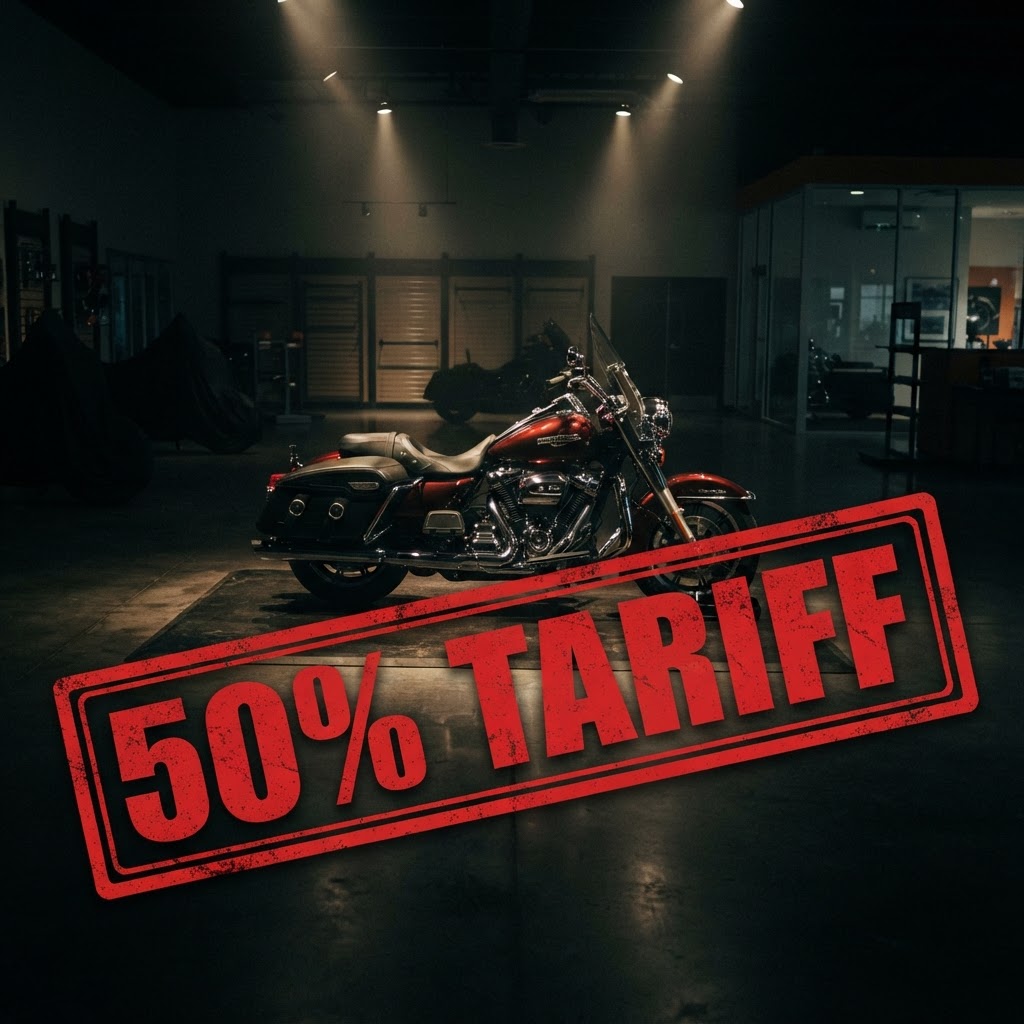
Canada's 50% Motorcycle Tariff: What It Means for Riders in 2026
Starting September 8, Canada hits US-origin motorcycles over 800cc with a 50% tariff. I talked to my local Indian dealership — they said next year's bikes could jump $10,000 to $15,000 CAD. If you have been sitting on the fence, this is your wake-up call.
Table of Contents
What Just Happened
On August 26, 2026, the Canadian government announced a sweeping round of counter-tariffs targeting $27.6 billion worth of US imports. The rates range from 15% to 50% across more than 700 product categories. And one of the biggest targets is motorcycles.
Beginning September 8, 2026, Canada will impose a 50% tariff on US-origin motorcycles with internal combustion engines larger than 800cc. That means every Harley-Davidson and every Indian Motorcycle heavyweight that crosses the border after that date gets hit with a massive new cost.
This is not a subtle policy tweak. A 50% tariff on motorcycles is a sledgehammer. And the timing is deliberate — Industry Minister Melanie Joly has said Ottawa is selecting products tied to specific US states to apply political pressure ahead of November's midterm elections. Harley-Davidson is headquartered in Milwaukee, Wisconsin. Indian Motorcycle is assembled in Spirit Lake, Iowa. Both states are being sent a message.
What My Local Indian Dealer Told Me
I ride an Indian Pursuit Dark Horse. I bought it used for $36,500 CAD about a year and a half ago, and it has been one of the best bikes I have ever owned. So naturally, when the tariff news broke, I called my local Indian dealership here in Atlantic Canada to ask what they were hearing.
What they told me was sobering: next year's models could increase $10,000 to $15,000 CAD depending on the model.
Think about that. An Indian Pursuit that might cost around $40,000 CAD today could be pushing $50,000 to $55,000 CAD next year. A Pursuit Elite or Signature Series — already north of $46,000 CAD — could be approaching $60,000. That is not a price adjustment. That is a different category of purchase entirely.
The dealer was clear that current inventory is safe. Motorcycles already sitting on Canadian showroom floors crossed the border before the tariff takes effect. But once that inventory sells through and replacement stock has to be imported after September 8, the math changes dramatically.
Which Motorcycles Are Affected
The tariff specifically targets US-origin motorcycles with internal combustion engines larger than 800cc. Here is what that means in practice:
| Brand | Origin | Affected? | Details |
|---|---|---|---|
| Indian Motorcycle | Spirit Lake, Iowa | Yes - all | Every Indian is assembled in Iowa. All heavyweight models (Chief, Challenger, Pursuit, Roadmaster, Sport Chief) are over 800cc. |
| Harley-Davidson | Various US plants | Yes - most | Nearly the full Canadian lineup exceeds 800cc. Nightster (975cc) starts at C$13,099. Street Glide: C$32,199. Street Glide Limited: C$42,949. |
| Honda | Japan / Global | No | Japanese and European brands are not US-origin and are not targeted by this specific tariff. |
| BMW | Germany | No | Not US-origin. Not directly affected. |
| Ducati | Italy | No | Not US-origin. Not directly affected. |
| KTM / Husqvarna | Austria | No | Not US-origin. Not directly affected. |
| Kawasaki / Yamaha | Japan | No | Not US-origin. Not directly affected. |
Important nuance: a 50% tariff does not automatically mean a 50% retail price increase. Tariffs are assessed on the customs value of the imported goods, not the final retail price. Manufacturers and dealers can absorb some of the cost. But a duty this large creates an enormous new cost somewhere in the chain — whether borne by the factory, the distributor, the dealer, or you, the buyer.
What This Means for Canadian Riders
If you ride an American bike in Canada, this is the most significant pricing event in years. Here is what to expect:
1. Current dealer inventory is your best opportunity. Bikes already on Canadian showroom floors are exempt. Dealers know this. Some may hold firm on pricing, knowing their replacement cost is about to jump. But others may want to move inventory before the market adjusts.
2. Used bike values are about to rise. If a new Indian Pursuit costs $50,000+ CAD next year, a clean used Pursuit at $36,000 starts looking like a steal. Expect the used market for American heavyweight motorcycles to tighten significantly through fall 2026 and into 2027.
3. Parts and accessories could also be affected. While the headline tariff targets complete motorcycles, the broader counter-tariff package covers hundreds of US products. OEM parts that cross the border could see cost increases, making maintenance more expensive for existing owners.
4. Japanese and European brands may look more attractive. A rider cross-shopping a Harley Street Glide against a Honda Gold Wing or BMW R 1300 GS just got a very strong reason to lean toward the non-American option — unless Harley and Indian can find a way to absorb the cost.
What This Means for US Riders
If you are in the United States, you might think this does not affect you. But it does, indirectly:
1. Reduced sales volume for American brands. Canada imported roughly $170.4 million worth of US motorcycles over 800cc in 2024. Harley-Davidson alone sold 6,434 motorcycles in Canada in 2025 — nearly 5% of its worldwide retail sales. Canadian sales have already softened, with Harley reporting 3,735 retail sales in H1 2026, down from 3,912 a year earlier. A 50% tariff will accelerate that decline.
2. Fewer resources for model development. When a manufacturer loses a meaningful chunk of its sales volume, that revenue funds R&D, new model development, and racing programs. Harley's "Back to the Bricks" strategy and Indian's product pipeline both depend on healthy sales numbers.
3. Potential US tariff retaliation on foreign bikes. The US has already been escalating tariffs on multiple fronts. If the US responds with further duties on imported motorcycles from Japan, Europe, or other markets, American riders could face higher prices on brands like Honda, BMW, and Ducati too.
4. Dealership impacts on both sides. Canadian Harley and Indian dealers face an existential threat — if customers walk away, dealerships close. On the US side, manufacturers absorbing tariff costs may cut dealer margins, affecting the health of US dealerships as well.
The Global Ripple Effect
This is not just a US-Canada problem. The tariff escalation has global implications:
Supply chain disruption. The US-Canada trade war is part of a broader pattern. The US has imposed tariffs ranging up to 125% on Chinese goods, with Chinese retaliation reaching 150%. Canada's counter-tariffs add another layer. Global supply chains for motorcycle components — from steel and aluminum to electronics and tires — are being squeezed from multiple directions.
European and Asian markets. While the Canadian tariff directly targets US-origin motorcycles, the trade war sets a precedent. Other countries may follow with their own retaliatory measures. European riders could see Harley and Indian prices rise if the US-EU trade relationship deteriorates further. Asian markets could see similar effects.
The USMCA question. The USMCA (the trade agreement that replaced NAFTA) is up for review in 2026. The return of tariffs and regulatory fragmentation would damage North America's position in global supply chains and reduce competitiveness against European and Asian manufacturers. If the trade agreement framework collapses, the motorcycle tariff situation could get worse, not better.
Steel and aluminum costs. Even riders who buy Japanese or European motorcycles are not fully insulated. Steel and aluminum tariffs raise manufacturing costs for all motorcycles, regardless of where they are assembled. A BMW R 1300 GS uses steel in its frame. A Honda Gold Wing uses aluminum in its components. Those raw material costs are global.
What You Should Do Right Now
Based on what my dealer told me and what the tariff schedule shows, here is my honest advice:
If you are on the fence about an Indian or Harley — buy from current inventory. Once that stock is gone, replacement bikes arrive with a 50% tariff baked into the cost. My dealer's quote of $10,000 to $15,000 CAD increases is not speculative — it is their honest read of what the numbers look like when you run the math.
If you own an American heavyweight, your bike just gained value. A used Indian Pursuit or Harley Street Glide sitting in your garage is now a more affordable alternative to a new one with a 50% markup. Do not be surprised if you start getting lowball offers from dealers wanting to stock up on pre-tariff inventory.
If you are cross-shopping non-American brands, you may have more leverage. Dealers of Honda, BMW, Yamaha, and other non-US brands know that American motorcycle prices are about to spike. They may be motivated to close deals with riders who were previously considering Indian or Harley.
If you are outside Canada and thinking about importing a bike, pay attention. The tariff applies to US-origin motorcycles imported into Canada. But the broader trade war could affect import/export dynamics in other countries too. Check your local tariff schedules before assuming prices will stay stable.
This Has Happened Before
In the mid-1980s, the Reagan administration slapped tariffs of up to 45% on Japanese motorcycles imported to the United States. The stated goal was to protect Harley-Davidson from Japanese competition. It worked — Harley survived, and the tariffs eventually expired.
But there was a cost. American riders paid more for Japanese motorcycles. The tariff did not just protect Harley — it limited choice and raised prices across the market.
Today's situation is the mirror image. Canada is targeting American motorcycles with a 50% tariff in response to US trade policy. The result will be the same: higher prices, fewer options, and riders caught in the middle of a political fight they did not start.
The difference now is that we have seen this movie before. We know how it ends. Prices go up. Some riders get priced out of the market. Dealerships struggle. And eventually, cooler heads prevail and tariffs come down. The question is how long that takes — and how much damage is done in the meantime.
FAQ
Related Articles
PowerPlus 108 to 112: How to Upgrade Your Indian Motorcycle - If you already own an Indian, upgrading might be cheaper than trading up. Indian Pursuit 10,000 km Ownership Report - Real-world ownership costs and experience. Top 5 Indian Pursuit Upgrades - Get more from the bike you already own. Solo vs Group Motorcycle Touring - Planning your next ride while prices are still reasonable.Sources: Forbes (Aug 26, 2026), Total Motorcycle (Aug 26, 2026), Government of Canada Department of Finance (Aug 2026), CBS News, CNN (Aug 25, 2026), National Post, MobileSyrup (Aug 28, 2026). Local Indian dealership conversation, August 2026. Pricing figures verified against Harley-Davidson Canada and Indian Motorcycle official listings as of August 2026.