Indian Pursuit vs Harley Road Glide: What 10,000 km Taught Me (2026)
In This Article
- Beyond the Spec Sheet
- Real Fuel Economy Numbers from 4,000 km of Touring
- What Stage 1 Exhaust Actually Does on Long Tours
- The Leg Heat Problem — Real Data from Both Camps
- 6 Speakers, 600 Watts: The Icon Audio Advantage
- Resale Value in Canada — The Honest Numbers
- What the Carolwood Sale Means for Your Pursuit
- 10,000 km Verdict
There's no shortage of Harley vs Indian comparison articles online. Most of them cover the same ground: engine specs, infotainment screens, seat height, starting price. I've already written that article. This isn't that.
This is what I've learned after 10,000 km (6,200 miles) on a 2024 Indian Pursuit Dark Horse Icon — including a 4,000 km (2,485 mile) run through Ontario for ECIC Muskoka 2026 with my Halifax IMRG crew. It's the stuff that doesn't show up until you're 600 km from home and committed. Fuel economy under real touring load. What Stage 1 mods actually change on long days. Why the Carolwood ownership acquisition matters to anyone currently making a buying decision. And the resale picture in Canadian dollars — which looks different from the US numbers most reviews use.
Beyond the Spec Sheet
By the time you're shopping at this level — Road Glide Limited vs Pursuit Dark Horse, $40,000+ CAD — you've probably read the spec sheets. You know the PowerPlus 108 makes more horsepower than the Milwaukee-Eight 117. You know both have frame-mounted fairings. You know both will get you across Canada.
What you don't know until you've actually done it is how these bikes behave when you're 8 hours into a day, 400 km from where you started, watching fuel range drop while trying to find a gas station on Highway 28 through Algonquin. That's where the real differences live.
Real Fuel Economy Numbers from 4,000 km of Touring
This is the data point that most comparisons skip because it requires actually doing the kilometres. Here's what I recorded on the ECIC Muskoka run — the most comprehensive real-world fuel data I have on the Pursuit.
Indian Pursuit Dark Horse Icon — ECIC Muskoka 2026
For comparison, the Harley Road Glide with the Milwaukee-Eight 117 consistently gets reported in the 5.8–7.2 L/100km (32–40 mpg US) range under similar conditions, with multiple owners citing 6.5+ L/100km when loaded. Over a 4,000 km tour that difference adds up to multiple extra fuel stops and meaningful dollars — especially with Canadian gas prices.
The Pursuit's full liquid cooling isn't just about heat management. It runs leaner and cleaner across a wider RPM range, and it shows up at the pump.
What Stage 1 Exhaust Actually Does on Long Tours
My Pursuit runs Indian's Stage 1 exhaust and Stage 1 air cleaner. I had these installed before the ECIC run and logged the difference. Here's the honest version — not the forum hype.
The Stage 1 slip-on exhaust adds a deeper, more authoritative note to the PowerPlus at low RPM without turning your bike into a noise complaint on every overnight stop. On the highway, it's barely louder than stock — the fairing absorbs most of it. At rest stops and in town it sounds noticeably better. That's the honest trade-off.
What it doesn't do: dramatically change power delivery in a way you'll notice at cruising speed. The PowerPlus 108 already pulls hard stock. The Stage 1 combo gives you slightly improved throttle response mid-range and more character at low speeds. For touring, I'd call it a quality-of-ride upgrade more than a performance upgrade.
The Leg Heat Problem — Real Data from Both Camps
I covered this briefly in a previous article but it deserves its own section with more detail because it's come up in nearly every conversation I've had with riders considering this decision.
The Road Glide's Milwaukee-Eight 117 uses liquid-cooled cylinder heads but an air/oil-cooled lower end. In slow traffic, at idle, in summer heat — the right side of the engine exhausts heat toward your right leg. Forum threads at roadglide.org and hdforums.com document this going back years. It's not universal — bike trim, weather, and riding position all factor in — but it's documented enough to be a real consideration for riders doing long summer days in Atlantic Canada heat.
On the Pursuit, the PowerPlus 108 is fully liquid-cooled — the heat goes to the radiator, not to your thigh. On the ECIC return through Ottawa in 30°C (86°F) traffic, sitting at a standstill for 20+ minutes, I had zero leg heat discomfort. That's not a small thing when you're doing 600 km days in July.
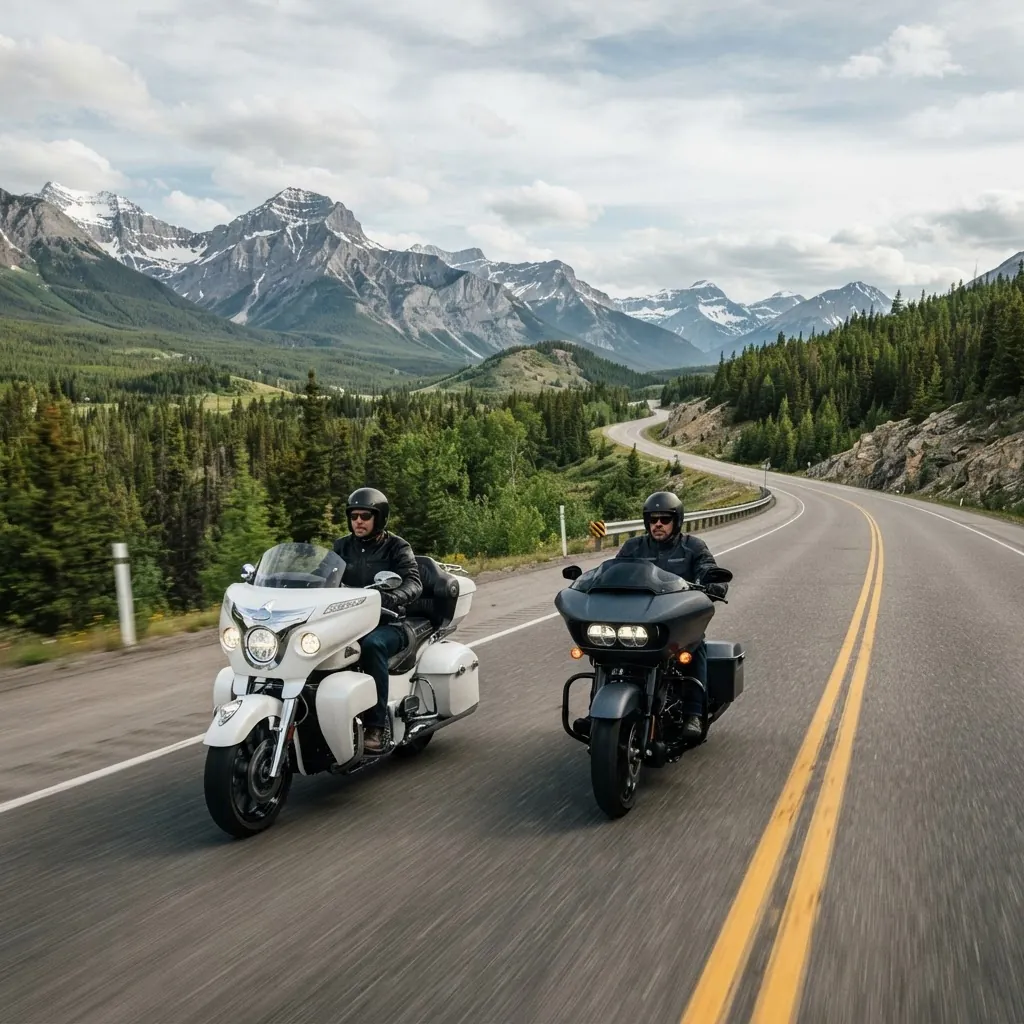
6 Speakers, 600 Watts: The Icon Audio Advantage
This is a Dark Horse Icon-specific point that doesn't get enough attention in generic Pursuit reviews, which typically describe the standard 4-speaker setup.
My Dark Horse Icon has a 6-speaker, 600-watt audio system — speakers in the fairing, tour-pak, and saddlebags. At highway speed, with the fairing absorbing wind noise, the system is genuinely loud and clear without distortion. I can listen at reasonable volume at 130 km/h (80 mph) without strain.
The Road Glide's Harman Kardon audio is the competitive benchmark here and it's very good. But the Icon's 600-watt system edges it out in raw output, particularly the rear-fill from the tour-pak and saddlebag speakers that creates a surround effect on long straight highways. If you're debating between standard Pursuit and Icon, the audio system alone justifies the step up for anyone who rides with music.
Resale Value in Canada — The Honest Numbers
This is where the conversation gets uncomfortable for Indian owners. Harley historically holds its value better in Canada. That's still true in 2026, but the gap is narrowing — and the context matters.
I paid $36,500 CAD for my 2024 Dark Horse Icon with 3,500 km on the odometer in November 2025. New MSRP for a comparable Dark Horse was $37,500–$42,000 CAD. That's a relatively shallow depreciation curve for a premium touring machine.
Canadian Resale Reality (2026)
The honest advice: if you're in a major urban centre with multiple Indian dealers, resale is not a serious concern. If you're in rural Atlantic Canada and the nearest Indian dealer is 3 hours away, factor that into your buying decision — for both service and eventual resale.
What the Carolwood Sale Means for Your Pursuit
In February 2026, Polaris completed the sale of a majority stake in Indian Motorcycle to Carolwood LP, a private equity firm. Indian is now a standalone company, separate from Polaris entirely. For anyone currently owning or buying a Pursuit, this is worth understanding.
The positive case: Carolwood and new leadership have publicly committed to a long-term strategy focused on Indian's core identity. 2026 marks Indian's 125th anniversary, and the brand has momentum. Being independent from Polaris could allow faster product development without competing for budget against snowmobiles and off-road vehicles.
The concern for current owners: the transition period is real. Warranty support, dealer network decisions, and parts availability are all now under new ownership priorities. My recommendation is to document your warranty status carefully and keep your service records with an authorized Indian dealer, not independent shops, for the next 12–18 months while the transition settles.
For buyers: the 2026 lineup is unchanged from what was planned under Polaris. The Carolwood sale didn't affect any current model year product. Your Pursuit is still the same machine it was before the sale.
10,000 km Verdict
After 10,000 km (6,200 miles) — including the hardest touring test I've put the Pursuit through — here's the updated take.
Fuel economy is a genuine Pursuit advantage: 5.8 L/100km (40.6 mpg US) loaded on a 4,000 km tour is real-world data, not manufacturer claims. The leg heat issue on the Road Glide is real and worth factoring in for Canadian summer riding. Stage 1 mods improve the character of the Pursuit without drama or warranty concerns. The Icon's 6-speaker, 600-watt audio is genuinely class-leading. And the Carolwood transition is something to monitor, not panic about.
The Road Glide is a legitimate machine. But 10,000 km in, I have zero regrets about the Pursuit. Every long day in the saddle confirms the decision.
Gear I Run on Every Tour
Insta360 X5 — Amazon.ca Insta360 X5 — Amazon.com Insta360 Ace Pro 2 — Amazon.ca Insta360 Ace Pro 2 — Amazon.com Antigravity A1 Drone — Amazon.ca Antigravity A1 Drone — Amazon.comFrequently Asked Questions
Is the Indian Pursuit better than a Harley-Davidson Road Glide?
For touring comfort and long-distance riding, the Indian Pursuit offers a more planted feel, better wind protection, and a more refined ride thanks to the rear suspension. The Road Glide has a larger infotainment screen and a bigger aftermarket. Both are excellent touring bikes — the Pursuit wins on ride quality, the Road Glide wins on ecosystem.
How much does an Indian Pursuit cost in Canada?
The 2024 Indian Pursuit Dark Horse Icon has an MSRP range of $37,500 to $47,600 CAD depending on trim and options. I paid $36,500 CAD for mine with approximately 3,500 km on the odometer.
What engine does the Indian Pursuit have?
The Indian Pursuit is powered by the PowerPlus 108 engine — a 1,768cc (108 cubic inch) liquid-cooled V-twin producing 122 horsepower and 128 ft-lbs of torque.
Is the Indian Pursuit good for long-distance touring?
After 10,000 km (6,200 miles) including a 4,000 km trip to Muskoka, Ontario, it proved excellent for long-distance touring. The 6-speaker 600-watt audio system, rear suspension, and weather protection make it a capable touring platform. Fuel economy is 5.8 L/100km (40.6 mpg US) on loaded solo touring.
Does Indian Motorcycle still exist after the Polaris sale?
Yes. Polaris sold Indian Motorcycle to Carolwood LP in February 2026. Indian continues to operate as a brand and produce motorcycles. The long-term impact on model lineup and dealer network remains to be seen.