Best Budget Action Camera 2026: Real-World Testing After 200,000 km
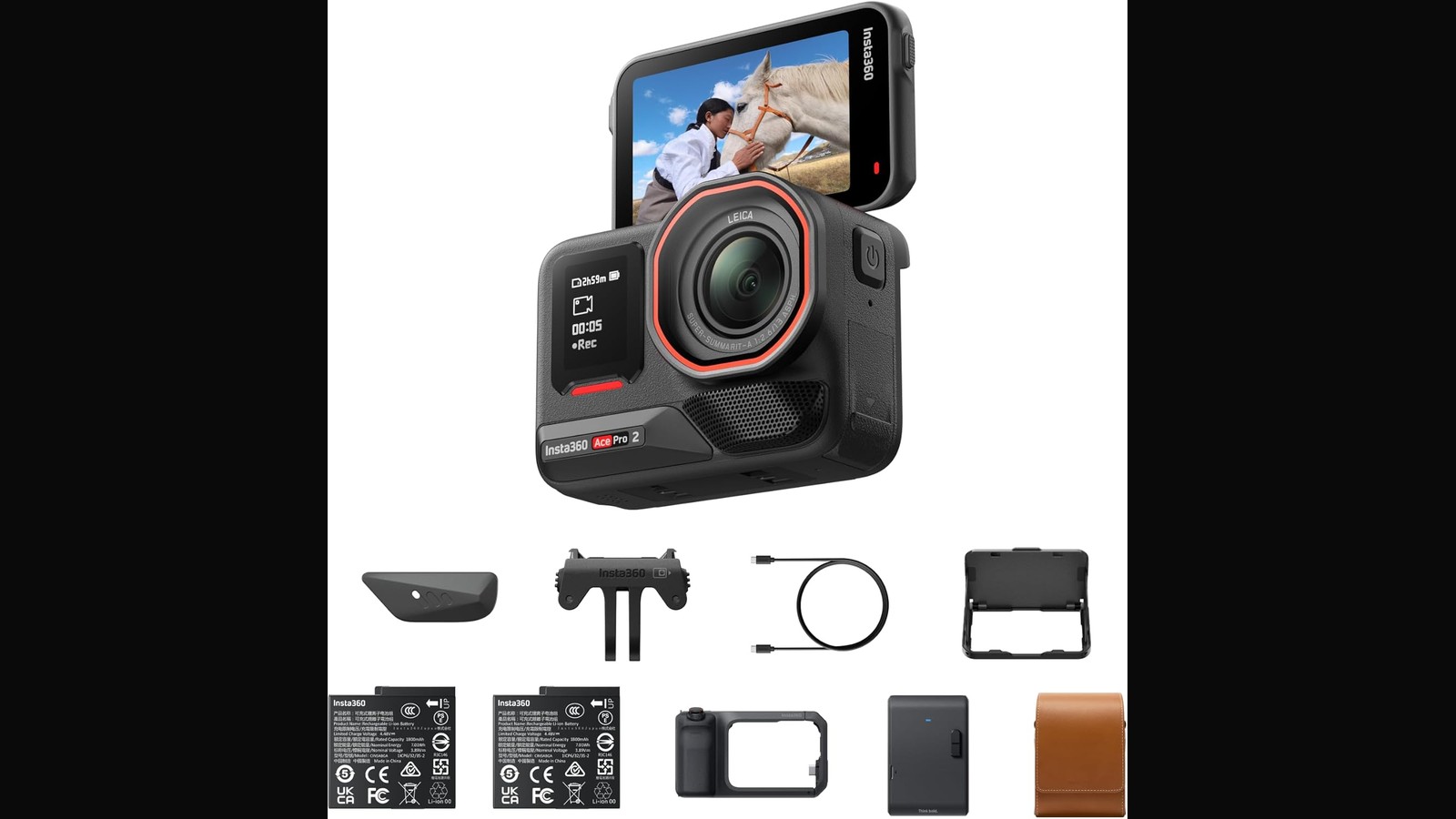
Image: Property of Insta360 and GoPro, Inc.
Most action camera reviews are written by people who test a camera for a weekend and return it. I own two Insta360 Ace Pro 2s, an Insta360 Ace Pro, two Insta360 X5s, an Insta360 Go Ultra, a GoPro HERO11, and a GoPro HERO13. I have filmed over 200,000 km of motorcycle riding across 28 states and provinces. Here is what actually matters when choosing a budget action camera — and which one I grab first.
Table of Contents
My Actual Camera Kit
Let me be transparent about what I own and why, because this is not a spec-sheet comparison. This is what I actually use:
- 2x Insta360 Ace Pro 2 ($340 each) — my go-to cameras for motorcycle riding. One mounted forward, one rear-facing. The AI noise cancellation handles wind better than anything else I have tested.
- 2x Insta360 X5 ($399 each) — my 360 cameras for vlogging and content where I want to reframe in post. Great for capturing everything and choosing the angle later.
- 1x Insta360 Ace Pro ($299) — the predecessor to the Ace Pro 2. Still a solid camera with great low-light performance, just without the latest AI features.
- 1x Insta360 Go Ultra ($399) — the upgraded pocket camera. Tiny, wearable, but with noticeably better image quality than the Go 3S. My go-to for quick, unobtrusive shots.
- 1x Insta360 Go 3S ($399) — the tiny camera I use when I want something invisible. Clips to a hat, weighs nothing, captures decent footage for its size.
- 1x GoPro HERO11 ($329) — still solid, still reliable. The accessory ecosystem is unmatched.
- 1x GoPro HERO13 ($330) — the newest GoPro. Better daylight footage than the Ace Pro 2, but worse in low light.
I film for two YouTube channels — @gregtoope (tech, ~200K subs) and @gregtooperides (motorcycles and travel, 17.5K subs). These cameras have been through rain, dust, heat, cold, and vibration across 200,000+ km of riding. This is not a lab test.
The Real Question: What Are You Filming?
The biggest mistake people make when buying an action camera is asking "which camera is best?" instead of "which camera is best for what I am doing?" Here is how I break it down:
If you are filming motorcycle riding, your priorities are: wind noise handling, vibration resistance, low-light performance (you ride at dusk and dawn), and one-handed operation with gloves on.
If you are filming action sports (skiing, biking, etc.), your priorities are: image stabilization, waterproofing, and mounting flexibility.
If you are vlogging or creating content where you do not know what you will film until it happens, your priority is a 360 camera that captures everything so you can choose the angle later.
If you are on a strict budget under $200, you are choosing between older GoPro models and the Insta360 Go 3S, and the answer depends on what you are mounting it to.
The Three Best Options Under $400
| Camera | Price | Best For | My Take |
|---|---|---|---|
| Insta360 Ace Pro 2 | $340 | Motorcycle riding, low light | My daily driver |
| GoPro HERO13 | $330 | Daylight action, ecosystem | Best traditional action cam |
| Insta360 X5 | $399 | 360 capture, reframing | Best for content creators |
Insta360 Ace Pro 2 — $340
This is the camera I mount on my Indian Pursuit every time I ride. Here is why it beats the GoPro for motorcycle use specifically:
- AI noise cancellation is not a gimmick. Wind noise at highway speeds destroys audio on most action cameras. The Ace Pro 2 uses AI to filter wind noise while preserving voice audio. I have tested this side by side with the HERO13 at 100 km/h, and the Ace Pro 2 audio is usable. The GoPro audio is not.
- Low-light performance is significantly better thanks to the larger sensor. When I ride at dawn or dusk (which is when the best motorcycle footage happens), the Ace Pro 2 produces clean, detailed footage. The HERO13 gets noisy in the same conditions.
- The magnetic mount is a small thing that matters a lot when you are wearing gloves. You snap the camera on and off the mount with one hand. No screwing, no threading. On a motorcycle, this is the difference between capturing a moment and missing it.
Where it falls short: the GoPro app ecosystem is more mature. The Insta360 app is good but not great, and the desktop software can be finicky. Battery life is comparable between the two — about 90-100 minutes of continuous recording.
GoPro HERO13 — $330
GoPro still makes the best traditional action camera for pure image quality in good lighting. If you are skiing, mountain biking, or doing any action sport in daylight, the HERO13 produces the sharpest, most color-accurate footage.
The accessory ecosystem is GoPro's biggest advantage. Every mount, every accessory, every third-party product works with GoPro. If you need a chest mount, a jaw mount, a suction cup, or a drone, GoPro has an official or third-party option. Insta360's accessory selection is growing but not as deep.
For motorcycle use specifically, the HERO13's weakness is wind noise. Even with the windslayer foam, highway speeds overwhelm the microphones. If audio matters to you on a motorcycle, this is a dealbreaker.
Insta360 X5 — $399
The X5 is a 360 camera, which means it captures everything around you and you choose the angle in post-production. This is a fundamentally different workflow.
The advantage: you never miss a shot. The camera is recording in every direction. When something happens — a bear on the side of the road, another rider doing something spectacular, a beautiful sunset — you do not need to have the camera pointed at it. You reframe in post.
The disadvantage: the workflow is slower. You have to reframe, render, and export. Traditional action cameras give you a finished file. 360 cameras give you raw material. For daily riding footage, the Ace Pro 2 is faster. For content creation where the shot matters more than the speed, the X5 is better.
The Motorcycle Test: What Actually Matters on a Bike
Here is what I have learned from mounting cameras to motorcycles for years, that no spec sheet will tell you:
Vibration kills footage. Motorcycle handlebars vibrate at specific frequencies that create jelly-like distortion in video. Both the Ace Pro 2 and HERO13 have electronic stabilization that handles this, but the Ace Pro 2's stabilization is slightly better for the specific vibration pattern of a big V-twin like my Indian Pursuit. If you ride a parallel-twin or inline-4, the vibration pattern is different, and both cameras handle it well.
One-handed operation is essential. When you are riding, you have one hand on the bars. Starting and stopping recording, changing modes, and mounting the camera needs to be doable with one hand while wearing gloves. The Ace Pro 2's magnetic mount wins here. GoPro's mounting system requires two hands to attach securely.
Battery management matters. A full day of riding with the camera running drains the battery in about 90-100 minutes. You need spare batteries, and you need to be able to swap them with gloves on. Both cameras are manageable here, but the Ace Pro 2's battery is slightly easier to seat with cold hands.
Rain happens. Both cameras are waterproof without a case. I have ridden through downpours with both, and both survived. The GoPro's waterproofing is rated deeper (10m vs 5m), but for motorcycle use, rain is the test, and both pass.
360 vs Traditional: Which Is Right for You?
If you are deciding between a 360 camera (X5) and a traditional action camera (Ace Pro 2 or HERO13), here is the honest guidance:
Get a 360 camera if you are creating content where the shot composition matters more than the speed of your workflow. If you are a YouTuber who edits footage and wants to reframe in post, 360 is liberating. You film everything and choose later.
Get a traditional action camera if you want to point, shoot, and have a finished video. If you are a motorcycle rider who wants to capture ride footage without a complex editing workflow, the Ace Pro 2 is simpler and faster.
Get both if you are serious about content creation. I run an X5 for 360 capture and an Ace Pro 2 for forward-facing footage simultaneously. The X5 captures everything. The Ace Pro 2 gives me a clean traditional shot without needing to reframe.
Mounting Made Simple
For motorcycle riders, the three mounts that matter:
- Handlebar mount — the classic. Shows the road ahead with the handlebars in frame. Works with both cameras.
- Helmet side mount — the most immersive POV. Camera sits on the side of your helmet. Better with smaller cameras like the Go 3S.
- Under-seat rear-facing mount — captures what is behind you. I run an Ace Pro 2 here for ride-behind footage. Critical for moto vlogging.
The Insta360 magnetic mount system makes swapping between positions faster than GoPro's system. If you frequently move your camera between positions during a ride, this is a real advantage.
My Honest Pick
If you ride motorcycles and want one camera under $400, buy the Insta360 Ace Pro 2 at $340. The low-light performance, wind noise handling, and magnetic mounting make it the best motorcycle action camera I have used. I own two because I always run forward and rear-facing cameras, and the Ace Pro 2 is the one I trust.
If you do not ride motorcycles and want the best all-around action camera, the GoPro HERO13 at $330 is the safer choice. Better daylight image quality, unmatched accessories, and the most reliable software ecosystem.
If you want the creative freedom of 360 capture, the Insta360 X5 at $399 is worth the extra $60. Reframing in post changes how you think about filming. You stop worrying about where the camera is pointed and start focusing on what is happening around you.
The thing no other review will tell you: the best camera is the one you actually have mounted when something worth filming happens. All three of these are excellent. The differences between them are smaller than the difference between any of them and not having a camera at all. Buy one, mount it, and go ride.