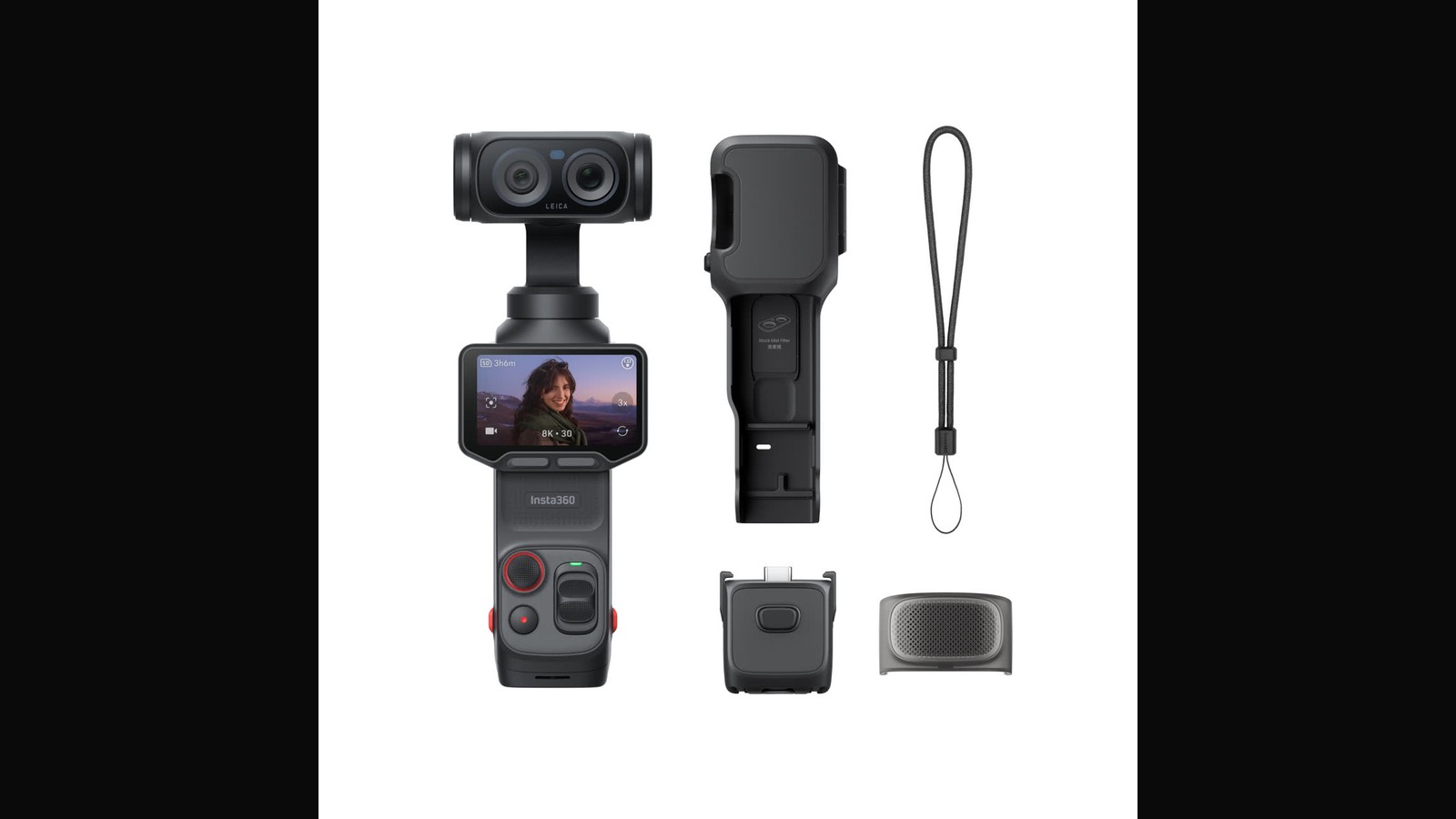
Image: Property of Insta360.
The DJI Osmo Pocket 3 finally has real competition. Insta360's Luna Ultra brings dual Leica lenses, a 1-inch 8K sensor, a detachable OLED remote, and 10-bit I-Log to the gimbal camera space — and it's earned an Editors' Choice from PCMag. I received a Luna Ultra in early August 2026 and have been testing it for about two weeks. Here's the full breakdown based on my hands-on time plus published reviews from PCMag and PetaPixel.
Disclosure: I received the Luna Ultra from Insta360 in early August 2026 and have been testing it for about two weeks. This article combines my hands-on experience with the published reviews from PCMag (Editors' Choice) and PetaPixel.
Insta360 previewed the Luna series at NAB Show 2026, and the flagship Luna Ultra is the company's first gimbal camera. It's not an action camera and it's not a 360 camera — it's a pocket-sized vlogging and creative camera with built-in 3-axis mechanical stabilization, dual lenses co-engineered with Leica, and a design that pushes what a compact creator camera can do.
This is a new category for Insta360. They've dominated 360 cameras (X5) and action cameras (Ace Pro 2), and now they're going after the gimbal camera space that DJI's Osmo Pocket series has owned since 2018. The timing couldn't be better for Insta360: DJI's Pocket 4 and dual-lens Pocket 4P are both banned from US sale after DJI was added to the FCC's Covered List in December 2025. That leaves the aging Pocket 3 as DJI's only available gimbal camera stateside — and Insta360 has stepped in with something genuinely better.
PCMag gave the Luna Ultra their Editors' Choice award, calling it "the best handheld video camera I've tested for YouTube, social media, and travel." PetaPixel praised the detachable screen as the standout feature but noted a few caveats around the small display and limited filter availability. Both reviews agree: this is a serious creative tool, not just a vlogging toy.
I received the Luna Ultra from Insta360 in early August 2026 and have been testing it for about two weeks. This article combines my hands-on time with published testing from PCMag and PetaPixel, plus my analysis as someone who runs two Insta360 Ace Pro 2 cameras on my Indian Pursuit. The Luna Ultra is a completely different tool — it's not rugged, not weatherproof, and not meant for motorcycle mounting. It's for sit-down product reviews, B-roll, and the kind of content where I need smooth gimbal movement without a full rig. For moto touring, the Ace Pro 2 still wins.
The Luna Ultra has a baton-style body that fits comfortably in one hand. It measures 6.7 x 2.0 x 1.5 inches (170 x 51 x 38 mm) and weighs 8.3 ounces (235 g) — pocketable but not featherlight. It's available in two colors: Cosmic Black and Stellar White.
The camera ships with a few modular components: an extension handle that snaps onto the bottom, a set of flip-out metal feet for setting it on a flat surface, and a standard 1/4-inch-20 tripod thread. The flip-out feet are a bit flimsy and the camera tips easily if bumped — if you plan to set it down frequently, a mini tripod is a worthwhile investment.
Crucially, the Luna Ultra is not rugged or weather-sealed. The gimbal mechanism is fragile and can break if dropped on a hard surface. This is a camera you handle with care — the opposite of an Ace Pro 2 or GoPro that you can toss in a tank bag. Insta360 includes a plastic protective case that holds the camera with the handle attached, and it has slots for a wide-angle conversion lens and black mist filter (both sold separately).
The Luna Ultra's defining hardware feature is its dual-lens system, both co-engineered with Leica:
| Feature | Main Lens (Wide) | Telephoto Lens |
|---|---|---|
| 35mm Equivalent | 20mm | 60mm |
| Sensor | Type 1 (1-inch) | Type 1/1.3 |
| Aperture | f/1.8 | f/2.0 |
| Max Resolution | 8K30 | 8K30 |
| Optical Zoom | 1x (2x digital in 4K) | 3x optical |
| Digital Zoom | — | 6x and 12x hybrid |
| Dynamic Range | 14 stops | — |
The 20mm wide lens is ideal for vlogging — it gives you that flattering wide perspective when the camera is arm's length away, with enough background context to establish a scene. The f/1.8 aperture combined with the 1-inch sensor delivers strong low-light performance and natural depth of field, roughly equivalent to a 20mm f/5 on full-frame.
The 60mm telephoto is the more interesting lens for creative work. It gives you a tighter, more cinematic look that's completely different from the wide-angle perspective typical of gimbal cameras. Both lenses can shoot 8K30, which is impressive for the telephoto given its smaller sensor. The 6x digital zoom is usable in 4K; the 12x starts looking soft. The telephoto also has a close-focus macro mode that's surprisingly capable for product detail shots.
Five focal lengths are available: 20mm, 40mm (2x digital from wide), 60mm (optical tele), 120mm (6x), and 240mm (12x). The 60mm and 6x are the sweet spots — beyond that, image quality drops noticeably.
If I had to name one feature that sets the Luna Ultra apart from every other gimbal camera, it's the detachable front plate. Squeeze the orange clips at the base and pull the panel out — you now have a wireless remote with a live view feed, full camera controls, and a built-in microphone.
"The detachable screen is the feature that makes this camera a genuine solo creator tool. No separate remote, no second person — just pop and shoot."
The 2-inch OLED touchscreen has 1000 nits of brightness, making it usable in direct sunlight. Insta360 claims a 20-meter (65-foot) wireless range, and in testing it worked reliably up to about 20 feet (6 meters) with some connectivity issues beyond that. The screen has a resolution of 564 x 318 pixels — over half a million dots, which is enough for framing but not for confirming critical focus. For precise focus checking, you'll want to pair the camera to the Insta360 phone app for a larger display.
The remote includes a microphone, so you can narrate while the camera sits on a tripod across the room. This would be incredibly useful for product reviews — set the camera up, frame the shot, then sit in front of it and talk while monitoring on the detached screen. No separate wireless monitor needed.
The screen does have limitations. Touch controls are cramped on 2 inches, and adjusting manual settings like ISO or shutter speed can be frustrating. The app is the better interface for anything complex. Also, the histogram is only available through the phone app — it doesn't show on the OLED screen, which is a gap for anyone shooting I-Log.
The Luna Ultra records in several modes:
All recording uses h.265 compression at up to 120Mbps, which keeps file sizes manageable but can be demanding on older computers during editing. A V30 microSD card with A1 speed rating is sufficient.
The Luna Ultra introduces 10-bit I-Log recording — a first for any Insta360 camera. This is significant. I-Log captures a flat, low-contrast image that preserves maximum dynamic range (14 stops) for grading in DaVinci Resolve or Premiere Pro. For anyone doing professional color work, this is the feature that moves the Luna Ultra from "nice to have" to "essential."
Beyond I-Log, the camera supports Dolby Vision HDR and a range of Leica color profiles. PetaPixel noted that the Leica looks add genuine style — they're not just marketing fluff. However, the filtered looks aren't available in all modes, and there's no black-and-white recording mode, which some filmmakers will miss.
For low-light shooting, the Luna Ultra has a dedicated PureVideo mode. This limits recording to 4K up to 60p and disables I-Log, but it produces noticeably cleaner footage in dim conditions. It can be manually selected or engages automatically when light drops. In testing against an iPhone 17 Pro's front camera, the Luna Ultra was dramatically sharper and less noisy — no contest.
The Luna Ultra has a built-in microphone that's decent for casual capture and monitoring. But for serious audio quality, you'll want a dedicated mic. The Creator Combo includes the Insta360 Mic Pro ($139.99 separately), which pairs wirelessly with the camera and has AI noise canceling, a 3-mic array with directional pickup modes, and a nifty color E-Ink display. For a lighter, more budget-friendly option, the Insta360 Mic Air ($75.99) weighs just 7.9g and clips on for run-and-gun audio.
The detachable screen also has its own microphone, which means you can record narration from up to 20 meters (65 feet) away from the camera body. This is a clever two-in-one: remote control plus wireless mic, no extra gear.
Insta360 claims up to 4 hours of battery life, but real-world testing tells a different story:
| Mode | Battery Life (tested) |
|---|---|
| 4K24 | ~150 minutes |
| 4K60 | ~130 minutes |
| 8K + slow motion heavy use | ~120 minutes |
The battery is internal and non-removable — you charge via USB-C. The Creator Combo adds a battery handle that snaps onto the bottom and provides roughly 50% more runtime (about 75 extra minutes at 4K24, 65 minutes at 4K60). For long shoots, you can also power the camera through USB-C while recording.
The camera gets warm during extended recording but never triggered an overheating warning in testing. For long-form clips, setting it on a tripod or table is better than handholding — less heat transfer and more stable footage.
Storage is handled via 47GB of built-in memory (good for about 65 minutes of 4K60) plus a microSDXC card slot. With 120Mbps max bitrate, a V30 card is all you need — no expensive V60 or V90 required.
The DJI Osmo Pocket 3 ($499) has been the default gimbal camera for YouTubers since 2023. The Luna Ultra ($769.99) costs 54% more. Is it worth the premium?
| Feature | Luna Ultra | DJI Pocket 3 |
|---|---|---|
| Price | $769.99 | $499 |
| Sensor | 1-inch | 1-inch |
| Lenses | Dual (20mm + 60mm) | Single (20mm) |
| Max Resolution | 8K30 | 4K120 |
| Screen | 2" detachable OLED | 2" fixed OLED |
| 10-bit Log | Yes (I-Log) | Yes (D-Log M) |
| Battery (tested) | ~130 min 4K60 | ~145 min 4K60 |
| Built-in Memory | 47GB | None |
| Wireless Remote | Yes (detachable screen) | No (phone app only) |
| US Availability | Available | Available (Pocket 4/4P banned) |
The Luna Ultra wins on versatility: dual lenses, detachable remote, 8K, built-in memory, and Dolby Vision. The Pocket 3 wins on price, slightly longer battery, and a more mature software ecosystem. If you already own a Pocket 3 and it's working for you, the Luna Ultra isn't a must-upgrade. But if you're buying fresh — especially in the US where the Pocket 4 and 4P are banned — the Luna Ultra is the better camera.
This is the question I get most: should you buy the Luna Ultra or the Ace Pro 2? I run two Ace Pro 2 cameras on my motorcycle for touring, so I can speak to that side of the equation from real experience. The Luna Ultra side is based on my two weeks of hands-on testing plus published reviews.
| Feature | Luna Ultra | Ace Pro 2 |
|---|---|---|
| Category | Gimbal vlog camera | Action camera |
| Stabilization | 3-axis mechanical gimbal | Electronic (FlowState) |
| Sensor | 1-inch | 1/1.3-inch |
| Lenses | Dual Leica (20mm + 60mm) | Single (fixed) |
| Max Video | 8K30 | 8K30 |
| Weatherproof | No | Yes (IP68) |
| Mountable on helmet/bike | No | Yes |
| Detachable Remote | Yes | No |
| 10-bit Log | Yes (I-Log) | Yes |
| Price | $769.99 | $399 |
These are completely different tools. The Ace Pro 2 is a rugged action camera that mounts on helmets, motorcycles, and chest harnesses. It's waterproof, drop-resistant, and built for rough handling. The Luna Ultra is a delicate precision instrument for handheld or tripod use.
For my content workflow: the Ace Pro 2 handles all motorcycle footage — highway runs, twisty roads, weather, the works. If I added a Luna Ultra, it would handle the studio side — sit-down reviews, product B-roll, talking-head segments where gimbal-smooth pans and a detachable remote matter. They'd complement each other; they don't compete.
Buy it if you:
Skip it if you:
The Luna Ultra comes in several configurations:
| Bundle | Price (USD) | What's Included |
|---|---|---|
| Standard Combo | $769.99 | Camera, handle, windguard, USB-C cable, wrist strap, protective case |
| POV Bundle | $862 | Standard + POV mount accessory |
| Creator Combo | TBA | Standard + battery handle (+50% runtime), wide-angle lens (15mm), Insta360 Mic Pro, zippered carrying case |
If you plan to do any narration or remote recording, the Creator Combo is the one to get. The Mic Pro alone is worth $139.99, and the battery handle solves the non-removable battery issue for longer shoots. The wide-angle lens expands the main lens to a 15mm equivalent — useful for tight spaces and dramatic establishing shots.
Buy direct from Insta360:
Insta360 Luna Ultra Insta360 Ace Pro 2 Insta360 Mic Pro Insta360 Mic Air Insta360 Accessories
Affiliate links — support the site at no extra cost to you.
| Pros | Cons |
|---|---|
| Smooth, stable gimbal video | Not rugged or weather-sealed |
| Dual Leica lenses (wide + tele) | Small screen — cramped controls |
| Detachable wireless remote with mic | Internal, non-removable battery |
| 10-bit I-Log, Dolby Vision, Leica looks | 4-hour battery claim is optimistic |
| 8K30 and 4K120 video | No black-and-white recording mode |
| 47GB built-in memory | Flip-out feet are flimsy |
| Good built-in audio + Mic Pro option | ND filters not included (needed for smooth motion) |
| Editors' Choice — PCMag | Filtered looks not available in all modes |
| DNG, JPG, and 360 panoramas | Gets warm during extended use |
| Subject tracking works well | 12x digital zoom is soft in 4K |
Sources: PCMag (Editors' Choice review, June 2026), PetaPixel (hands-on review, June 2026), Insta360 official product page, Insta360 store. Battery life figures from PCMag testing. Image quality observations from PetaPixel testing. Pricing as of August 2026.