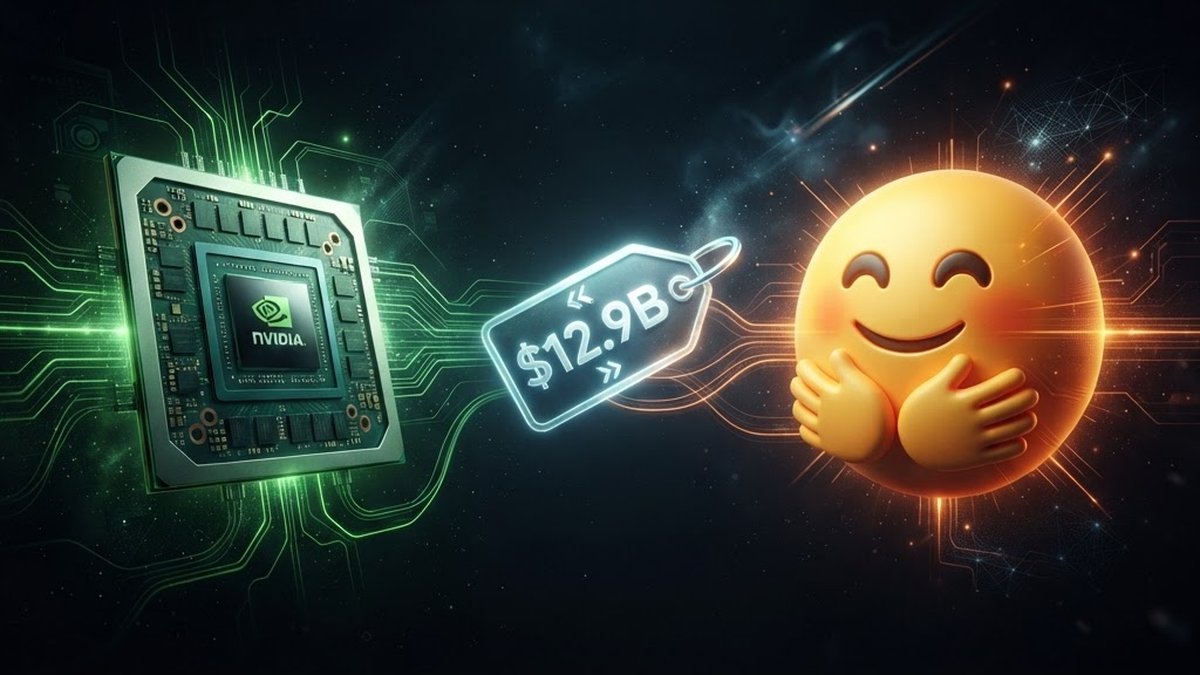
Nvidia has agreed to acquire Hugging Face for $12.9 billion, as reported by The Information on August 26, 2026. It is one of Nvidia's largest acquisitions to date and a move that could reshape the open-source AI landscape. But what does it actually mean for developers, creators, and anyone who uses AI tools?
If you are not deep in the AI world, you might know Hugging Face only by name. Think of it as the GitHub of AI models. It is the largest repository of open-source AI models on the internet, hosting over 1 million models from companies like Meta (Llama), Google (Gemma), Microsoft, and thousands of independent researchers and developers.
Hugging Face also hosts datasets, provides tools for training and deploying models, and has become the central hub where the open-source AI community shares and collaborates. If a developer wants to use an open-source language model, image generator, or speech-to-text system, Hugging Face is usually the first stop.
Nvidia already dominates AI hardware. Its GPUs power the vast majority of AI training and inference worldwide. But hardware alone is not the full stack. By acquiring Hugging Face, Nvidia gets:
As Jensen Huang, Nvidia's CEO, has positioned himself as a champion of open-source AI, this acquisition could be framed as a commitment to keeping AI open. But the reality is more complex.
For context, $12.9 billion is more than what Microsoft paid for GitHub ($7.5 billion in 2018) and significantly more than what Amazon paid for MGM ($8.5 billion in 2022). It signals that Nvidia sees Hugging Face as strategic infrastructure, not just a software company.
In the immediate future, Hugging Face will likely continue operating as before. Nvidia is not going to shut down the platform that millions of developers rely on. The models, datasets, and tools will remain available. If you use Hugging Face today, you can probably keep using it tomorrow.
The bigger question is long-term. Will Nvidia use Hugging Face to push developers toward its GPU ecosystem? Will models optimized for AMD or custom chips get less visibility? Will Nvidia introduce paid tiers for features that are currently free? These are the concerns the community is wrestling with right now.
There is also a positive scenario: Nvidia could invest heavily in Hugging Face's infrastructure, making it faster and more capable. More compute resources for the open-source community could accelerate model development. Nvidia has already been launching open models and datasets on the platform, which suggests at least some commitment to openness.
The open-source AI community has mixed feelings about this acquisition. On one hand, Nvidia has been a strong supporter of open-source AI. On the other hand, a single company controlling both the dominant hardware platform and the dominant model repository creates significant concentration of power.
Key concerns raised by the community include:
This acquisition does not happen in a vacuum. The AI industry is in the middle of a massive consolidation wave:
Nvidia buying Hugging Face is, in part, a defensive move. If OpenAI, Google, or Amazon build closed ecosystems that pull developers away from Nvidia hardware, Hugging Face gives Nvidia a way to keep developers in its orbit.
Sources: The Information (August 26, 2026), Reuters, TechCrunch, CNBC, Hacker News community discussion.
Some links in this article are affiliate links. If you purchase through them I may earn a small commission at no extra cost to you. All opinions are my own based on real-world use.