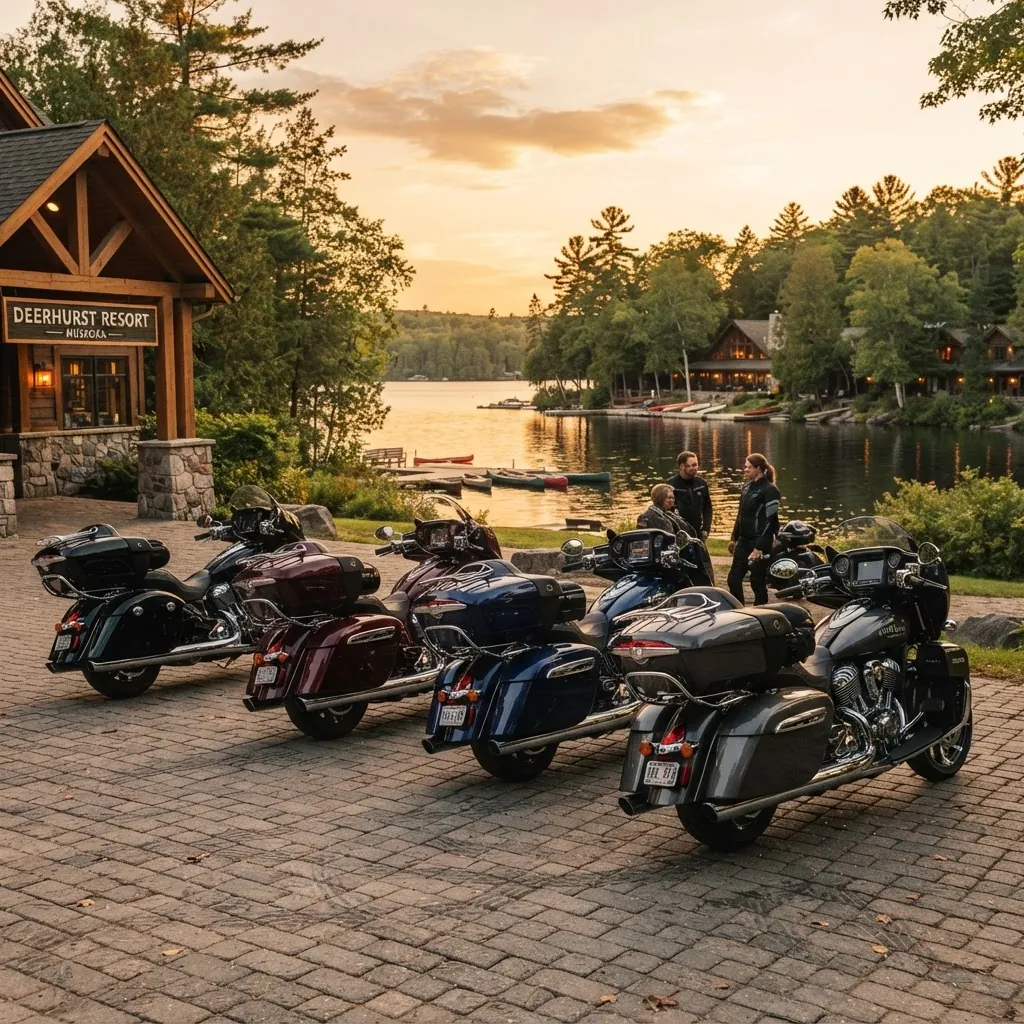
ECIC 2026: 4,000 km to Muskoka and Back on the Indian Pursuit
Table of Contents
- Trip Overview & Route Summary
- Day 1: Dieppe to Quebec — Sun, Rain, and Everything Between
- Day 2: Around Montreal, Through Algonquin Park
- Day 3: The Rest Day
- Day 4: First Group Ride — Muskoka Roads and Dream Catchers
- Day 5: AI-Designed Route, Waterfalls, and the Banquet
- Days 6-8: The Ride Home (and the Crash)
- Gear Used on This Trip
- The Takeaway
Trip Overview & Route Summary
Every summer, I try to get out on at least one longer motorcycle trip. This year, that trip was to Muskoka, Ontario for ECIC — the Eastern Canadian IMRG Celebration. This was the third annual event, and IMRG stands for Indian Motorcycle Riders Group. A few days of riding, hanging out with other riders, seeing some nice roads, and just getting away on the bike for a bit.
Over 200,000 km (124,000 miles) of riding over my lifetime, and trips like this are still what it's all about. This one covered roughly 4,000 km (2,485 miles) over eight days, starting and ending in Dieppe, New Brunswick, with a whole lot of everything in between.
The route followed the Trans-Canada Highway corridor from New Brunswick through Quebec and into Ontario — one of the most common long-distance riding routes in eastern Canada. If you're planning a similar trip from the Maritimes to central Canada, here's what the corridor looks like:
Outbound: Dieppe NB → Moncton → Fredericton → Grand Falls → Edmundston → Rivière-du-Loup QC → Lévis/Quebec City → Highway 30 toll around Montreal → Ottawa → Renfrew → through Algonquin Park (Highway 28) → Horseshoe Valley Resort. Roughly 1,400 km (870 miles) over two days.
Return: Horseshoe Valley → through Algonquin Park → Renfrew → Ottawa → Highway 30 toll around Montreal → Quebec → Edmundston NB → Dieppe NB. Same route in reverse, broken into three days for a more relaxed pace.
Route Planning Tip: Instead of fighting through downtown Montreal, we took Highway 30 (Autoroute 30) — the tolled south-shore bypass that loops around the city. It costs a few dollars but saves you from Montreal traffic and construction, and keeps you moving. From there, heading north through Ottawa, Renfrew, and across Highway 28 through Algonquin Park is a far more scenic ride than the 401 corridor. The trade-off: fewer gas stations, so fill up whenever you can.
Day 1: Dieppe to Quebec — Sun, Rain, and Everything Between
Dieppe to Fredericton (NB Route 2, ~180 km / 112 miles)
The trip started early. The bike was all packed up and I left the house around 7 AM. Nice blue sky, sunny, everything looked great — one of those perfect starts to a trip. I was pretty excited to get going.
My first stop was in Moncton to meet up with Raye at the gas station. From there, the two of us headed toward Fredericton to meet up with Kent, who was going to be our third rider. Nice weather, bikes packed, and we were finally on the road.
But about 20 minutes into the ride, the rain started. And it wasn't just a little bit that comes and goes — it pretty much stayed with us for a good part of that first morning.
NB Route 2 between Moncton and Fredericton is a good-quality divided highway, mostly straight with gentle rolling terrain through the Saint John River valley. It's about 180 km (112 miles) and normally takes about 1 hour 45 minutes. Gas stations are plentiful along this stretch — there are stops at Sussex, Petitcodiac, and Jemseg if you need fuel or a break.
Weather Note: Summer mornings in the Maritimes can start clear and flip to rain quickly, especially in June and July. The Fundy coastal influence means weather systems can move in fast. Check Environment Canada's radar before departing, but also pack rain gear even when the morning looks perfect — I did, and it saved me on this day.
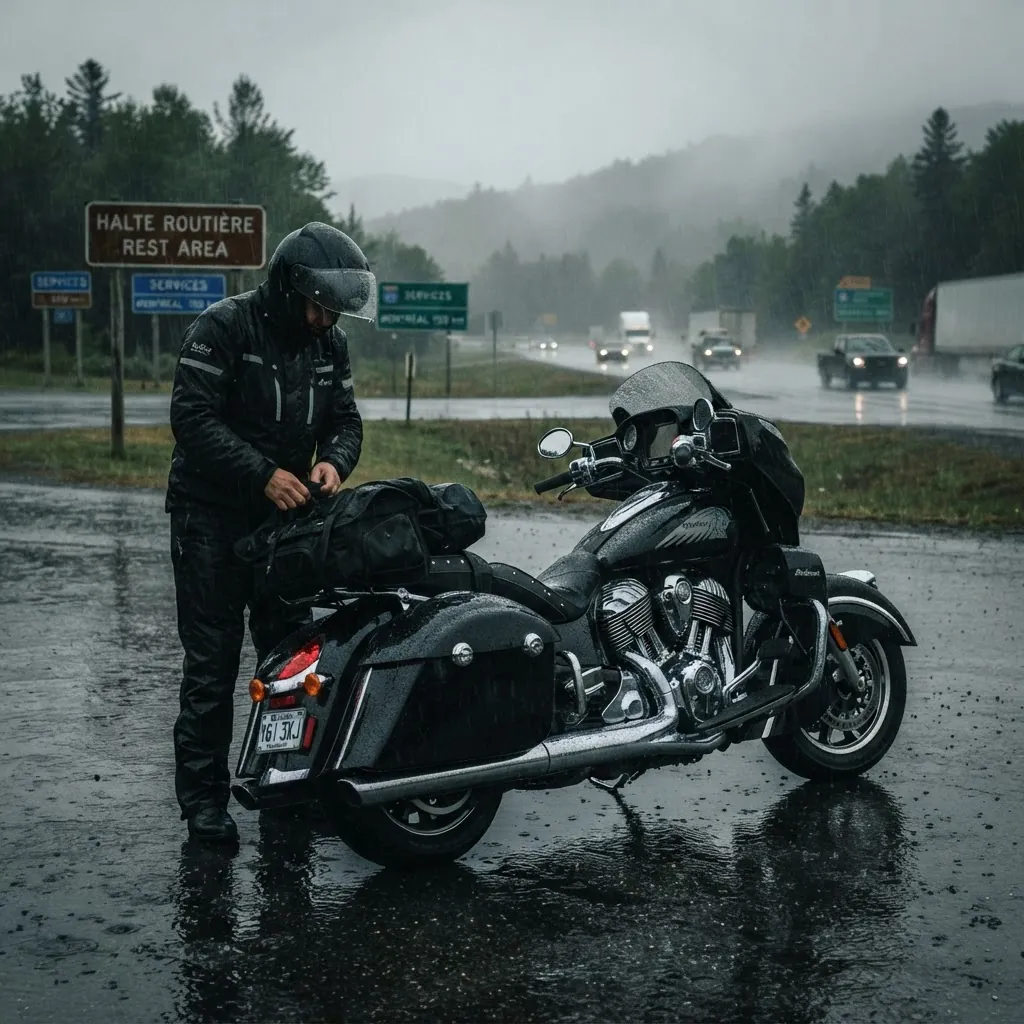
Rain riding through Quebec on Day 1 — just part of the trip.
Fredericton to Edmundston (NB Route 2, ~250 km / 155 miles)
By the time we picked up Kent in Fredericton, we were already into the rain, and the three of us just continued on in it. And that's just part of doing a motorcycle trip. You can plan your route, pack your gear, check the forecast a hundred times, but once you're on the road, you deal with whatever the day gives you.
We finally got a break from the rain around Grand Falls, and that break lasted until Edmundston. Nice to not be getting poured on for a stretch. But after Edmundston, the rain came back — and it came down hard.
Route 2 from Fredericton to Grand Falls follows the Saint John River north through Woodstock and Perth-Andover. It's scenic even in the rain — the river valley is wide and green, and the road is generally well-maintained with good sightlines. Grand Falls is a natural fuel and coffee stop — there's an Irving station right on the highway and a Tim Hortons in town.
From Grand Falls to Edmundston is about 65 km (40 miles) of rolling hills transitioning into the Madawaska region. The rain break we got between Grand Falls and Edmundston was a welcome relief — this stretch actually has some nice sweeping curves along the river that are enjoyable in dry conditions.
Gas Tip: The stretch between Grand Falls and Edmundston has limited fuel stops. Top up in Grand Falls if you're below half a tank — the Indian Pursuit has a 22.7L (6.0 gal) tank and a range of about 320-360 km (200-225 miles), but in heavy rain with a loaded bike, you'll burn more fuel than usual.
Edmundston to Rivière-du-Loup (QC Route 85/185, ~115 km / 72 miles)
After Edmundston, the rain came back hard and stayed with us until Rivière-du-Loup. This stretch crosses from New Brunswick into Quebec via Route 85 (which becomes Route 185), passing through the Temiscouata region. It's a mostly two-lane highway through forested hills — beautiful in dry weather, but in heavy rain, the reduced visibility and slick surfaces make it a stretch you want to take carefully.
Route 185 has been progressively upgraded to a divided highway (Route 85), but there are still sections of two-lane road with construction zones. If you're riding this corridor, expect some construction during summer months — Quebec does most of its road work between June and September.
Rivière-du-Loup to Lévis (QC Route 20, ~200 km / 124 miles)
But after Rivière-du-Loup, things finally changed. The rain stopped, the sun came out, and from there it turned into a completely different day. By the time we were into Quebec, it was around 28°C (82°F) for the rest of the ride. We went from wet and cold, to a short break, back into heavy rain, and then finally into sunny and hot — all in one day.
Route 20 from Rivière-du-Loup to Lévis follows the south shore of the St. Lawrence River. This is classic Quebec riding — long straight stretches with the river on your right, small towns and farmland on your left. On a clear day, you can see across the river to the north shore. The temperature change as you move east to west along the St. Lawrence can be dramatic — Maritime air gives way to continental climate, and the temperature can jump 10-15°C (18-27°F) in a couple hundred kilometres.
Weather Note: The St. Lawrence corridor is known for rapid weather shifts. The river creates its own microclimate, and temperature swings of 15°C (27°F) in a single day are normal in summer. Pack layers — you may start in a rain suit and end in a mesh jacket, sometimes within hours. I did exactly that on this day.
Lévis Construction and Overnight Stop
Of course, no road trip is complete without construction. We hit some pretty bad stuff in Lévis, Quebec, and it added about 45 minutes to our day. After already being on the bike for hours, that's not exactly what you want to see. But eventually we got through it.
Lévis sits directly across the river from Quebec City, connected by the Pierre Laporte Bridge and the Quebec Bridge. Summer construction is a near-constant on the approaches to both bridges — if you're passing through this area, check Quebec 511 (quebec511.info) for construction updates before you ride. The bridge area is also high-traffic during weekday rush hours, so early morning or evening passage is smoother.
That night, we stopped at a motel about halfway between Lévis and Montreal. After the rain, the construction, and all the riding, it felt really good to park the bikes, get cleaned up, relax, and go for a well-deserved dinner. Day one — a bit of everything. Sun, rain, heavy rain, heat, construction, and a lot of kilometres.
Accommodation Tip: The stretch between Lévis and Montreal along Route 20 has plenty of motel options in towns like Montmagny, Lévis, and Drummondville. We found a mid-point motel that worked well for a one-night stop. In peak summer season, booking ahead is smart — especially on weekends when Quebec cottagers are also on the move.
Day 2: Early Start, Bigger Group, Ontario Bound
Around Montreal on Highway 30, Then North Through Algonquin
Day two started very early. We'd reached out to another group that had left a day earlier than us, and we figured if we left early enough, we might be able to catch up with them on the other side of Montreal. By 6 AM, we were back on the bikes and heading out.
By around 8:15 AM, we actually caught up with them. Our little group of three bikes turned into a bigger group — they added another five bikes to our three. I have to say, it was nice riding with a bigger group for that part of the trip.
Highway 30 Toll Tip: Instead of riding through downtown Montreal, we took Autoroute 30 — the tolled highway that loops around the south side of the city. It's a bypass that keeps you off the island entirely, avoiding Montreal traffic, construction, and bridge delays. The toll is modest (a few dollars) and well worth it on a motorcycle — you keep moving instead of sitting in urban congestion. You can pay at the toll booth or online within 48 hours.
Day two was still a long day, but thankfully, no rain. Just one of those days where you're putting on the kilometres, making your stops, staying together as a group, and slowly getting closer to the destination. From the Highway 30 bypass, we headed north toward Ottawa, then continued to Renfrew before cutting through Algonquin Park on Highway 28.
Highway 28 through Algonquin Park is one of the best riding roads in Ontario. It cuts through the heart of the park — dense forest, lakes on both sides, sweeping curves through Canadian Shield terrain. It's not a fast road — the speed limit is 60-80 km/h (37-50 mph) through most of it — but that's not the point. It's about the scenery and the ride.
Gas Warning — Algonquin Park: There are very limited gas stations along Highway 28 through Algonquin Park. The last reliable fuel before entering the park from the Renfrew side is in the towns approaching the park boundary. Once you're inside, you're riding through 50+ km (30+ miles) of wilderness with no services. Top up before you enter the park — running out of gas here means a long walk or an expensive tow. The same applies if you're riding the park from the east side — fill up in Pembroke or Petawawa before heading west.
By mid-afternoon, we made it to Horseshoe Valley Resort in Ontario — that's where the ECIC event was being held. Horseshoe Valley is in the Oro-Medonte township, about 20 minutes north of Barrie. It's a four-season resort area — ski hills in winter, golf and hiking in summer, and some genuinely great motorcycle roads in the surrounding hills.
After two long days of riding from New Brunswick into Ontario, it felt pretty good to finally arrive. That feeling when you get to the resort after a long ride, and you can finally unpack and know you don't have to get back on the bike for another big travel day right away? That was a good feeling.
Day 3: The Rest Day
Day three was basically a rest day for me. The weather didn't look great, and they were calling for quite a bit of rain. In the end, we didn't really get as much as they said, but I was still okay with taking it easy. After two full days of riding, I needed it.
Sometimes on these trips, you feel like you should always be doing something — always riding, always filming, always going somewhere. But honestly, sometimes you just need a day to slow down and recharge. So that's what day three was. A slower day, a rest day, and a chance to get ready for the next couple of rides.
Rest Day Tip: If you're doing a multi-day trip like this, build in a rest day — especially after two consecutive long riding days. Your body needs it, your focus needs it, and it makes the riding days that follow more enjoyable. Horseshoe Valley has trails, a pool, and nearby Barrie has everything you need for bike maintenance or gear resupply.
Day 4: First Group Ride — Muskoka Roads and Dream Catchers
Riding the Muskoka Region
Day four was our first group ride. This was supposed to be a six-hour ride, but once you add in all the stops, it turned into more like 10 or 11 hours. And that's pretty much how group rides go. You stop for gas, then someone needs something, then you stop for lunch, then you stop for ice cream, then you stop again — and before you know it, the six-hour ride is a full-day event.
But it was a really good day. The weather was nice, but it was hot. We had a group of about eight bikes, and the pace was really good — nice and easy, nobody pushing too hard. We got to ride some really nice roads in the Muskoka area.
Muskoka really is a beautiful place to ride. You've got the lakes, the trees, the small towns, the winding roads, and just a totally different feel than riding back home in New Brunswick. The region sits on the Canadian Shield — granite outcrops, pine forests, and hundreds of lakes — which means the roads tend to follow the terrain with sweepers and gentle curves rather than long straight stretches.
Muskoka Riding Roads: Highway 28 through Algonquin Park — which we also rode on the way to and from the resort — is one of the highlights (great sweepers through dense forest, lakes on both sides), Muskoka Road 169 around Lake of Bays, and Southwood Road (Muskoka Road 13) which connects Gravenhurst to Bala with a nice mix of curves and lake views. Speed limits are generally 60-80 km/h (37-50 mph) on these secondary roads — they're not about going fast, they're about the scenery.
And riding around the Muskoka area, one thing you notice pretty quickly is that there's definitely a lot of money around there. Some really big homes, beautiful cottages, amazing properties along the water. I think I saw more Corvettes and Ferraris riding around that area than I've pretty much ever seen before. Between the roads, the scenery, the lakes, the cottages, and all the high-end cars, Muskoka definitely has a different feel. It's beautiful, but you can tell it's also a very wealthy area.
We also stopped at a place that had the largest dream catcher — kind of a cool little roadside stop. That night, we were back at the resort for a buffet dinner, and after a hot 10- or 11-hour day on the bike, I was pretty much ready for an early night.
Weather Note: Muskoka in summer runs hot and humid — daytime temps of 28-33°C (82-91°F) are common in July. On a 10-hour group ride in full gear, hydration is critical. We stopped frequently, which helped, but make sure you're drinking water at every stop, not just coffee. Dehydration on a long hot ride will wreck your focus by hour 6, and that's exactly when you need it most.
Day 5: AI-Designed Route, Waterfalls, and the Banquet
A Slower Pace and Sightseeing
Day five ended up being one of my favourite days of the trip. The day before was more about the ride itself — we rode some great roads but didn't really stop and see a lot of sights. So for day five, I decided to put together a shorter ride. And yes, I used AI to help design the route.
The idea was to find some good roads, but also make it more of a sightseeing day. Not just ride all day, but actually stop, look around, and enjoy the area a little bit. And honestly, it worked out really well.
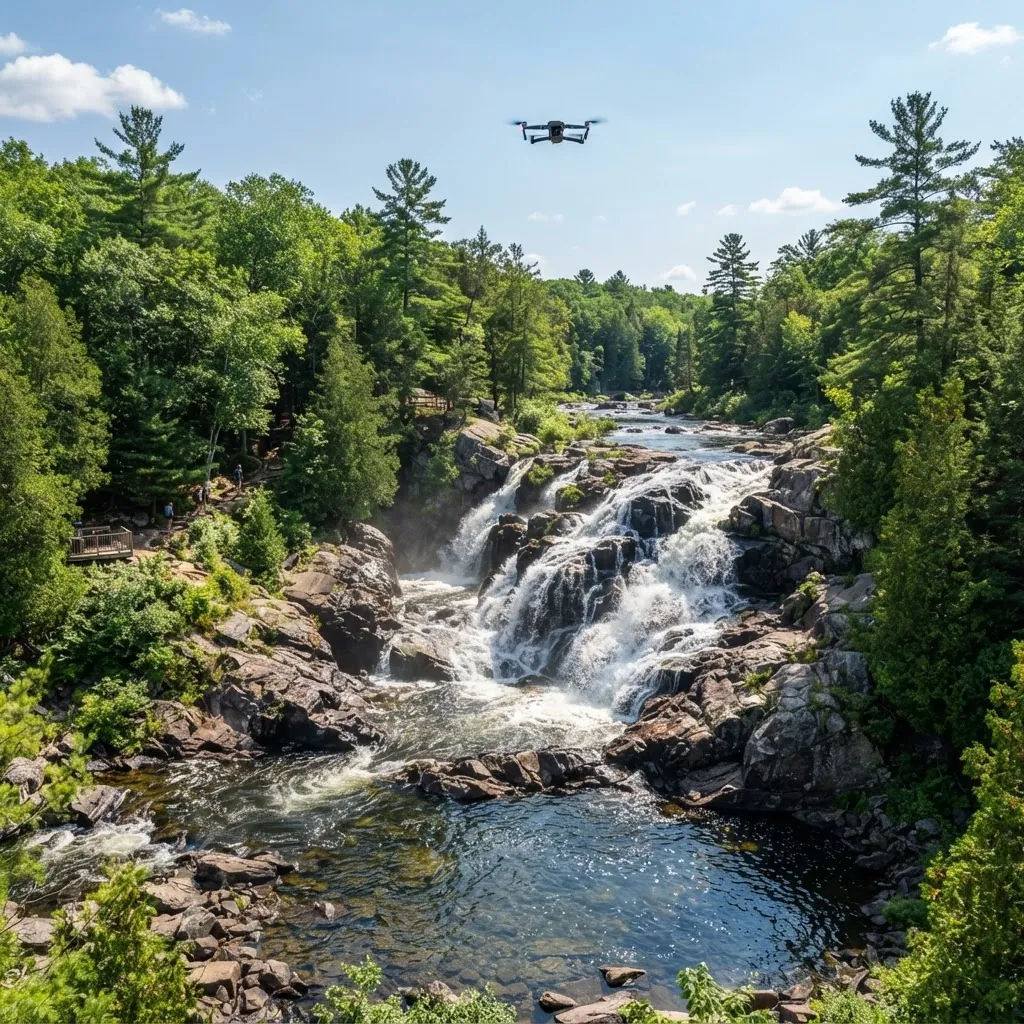
One of two waterfalls we stopped at on Day 5 — drone was up for this one.
We ended up on some great roads, but we also stopped at a bakery, had some ice cream, checked out a couple of old general stores, and stopped at two different waterfalls. And this is the kind of riding day I really like.
Muskoka Waterfalls: The Muskoka region has several accessible waterfalls worth a stop on a motorcycle ride. High Falls near Bracebridge is a popular one with easy parking, and Wilson's Falls in Bracebridge is a short walk from town. Both are drone-friendly spots as long as you're outside any restricted airspace — check the Nav Canada drone flight rules before launching. A sub-250g drone like the Antigravity A1 (249g) doesn't require registration in Canada, but you still need to follow basic safety rules.
Don't get me wrong, I love a good long ride. The roads, the sound of the bike, the scenery going by, getting into that rhythm of riding. But sometimes, you need to slow down a bit. Pull over, take the helmet off, and actually enjoy where you are. The waterfalls were a perfect example of that — a chance to stop, relax, take in the sights and sounds, and get some drone footage too.
I think that's something I'm trying to do a little more on these trips. Not just ride through everything. Actually stop once in a while and enjoy the places I'm riding to. Because sometimes the best parts of a motorcycle trip aren't just the roads — they're the little stops along the way. The places you probably wouldn't have seen if you were just rushing to get kilometres in.
The ECIC Banquet
We were back at the resort by mid-afternoon, which gave us time to relax before the banquet that night. The banquet was for the third annual ECIC event — a nice way to wrap up. You get to see riders from different areas, talk bikes, talk trips, and just be around people who enjoy the same thing you do. After the banquet, we said our goodbyes and called it an early night, because the next morning we were starting the ride home.
Days 6-8: The Ride Home (and the Crash)
Three Days Instead of Two — Same Route in Reverse
Instead of trying to ride home in two really long days, we decided to break the ride home into three days. We took the same route back in reverse: from the resort, back through Algonquin Park on Highway 28, down through Renfrew and Ottawa, then around Montreal on the Highway 30 toll, and back through Quebec toward New Brunswick.
Day six got us partway through Ontario. Day seven we made it to Edmundston, New Brunswick. And day eight got me back home to Dieppe.
Return Route Gas Tip: The same fuel warning applies in reverse — fill up before entering Algonquin Park from the Horseshoe Valley side. There are gas stations near the park's east entrance, but once you're on Highway 28 heading west, services are sparse. Plan your fuel stops at town boundaries and don't push your range — the Indian Pursuit has a 22.7L (6.0 gal) tank with about 320-360 km (200-225 miles) of range, but loaded touring in hilly terrain will burn more than you expect.
For the most part, the ride home was good. The first two days coming back were hot, and then on the morning of day three, leaving Edmundston, we had some rain again. So the rain made another appearance, just to remind us it was still part of the trip.
The Ottawa Incident
But the biggest issue on the way home happened coming through Ottawa. Traffic came to a quick stop. I was able to stop in time, but unfortunately, the bike behind me wasn't able to stop quick enough. They clipped the rear right saddlebag on my bike — damaged it pretty good. There was cosmetic damage, but it also damaged the function of it. The top and the lock broke completely, so we had to use some bungee cords to secure it for the rest of the ride.
Thankfully, the bike was still rideable, and no one was seriously hurt. But it was still a pretty good hit. And a couple of days later, I could definitely feel it in my back and neck. So I guess every motorcycle trip needs a little bit of excitement, but that's definitely not the kind of excitement I was looking for.
Ottawa Traffic Warning: Ottawa's Highway 417 (the Queensway) is known for sudden traffic stops, especially through the downtown core and near the splits to Highway 416. If you're riding through Ottawa on a motorcycle, keep extra following distance, watch brake lights several cars ahead, and be prepared for quick stops. Summer construction zones make it worse. Consider taking Highway 7 through Carleton Place as an alternate route — it's two-lane but much less stressful on a bike, and only adds about 20 minutes.
Now that I'm home, I'm waiting to hear back from insurance and see what happens with the damage.
Gear Used on This Trip
I carry a solid camera kit on trips like this to capture the roads, the stops, and the scenery from every angle. Here's what was on the bike for ECIC 2026:
My Camera Kit
Insta360 X5 — 360° camera for immersive ride footage and drone-free aerial shots.
Amazon.ca: https://www.amazon.ca/dp/B0DZCBYCNY | Amazon.com: https://www.amazon.com/dp/B0DZCBYCNY
Insta360 Ace Pro 2 — Action camera for point-of-view riding footage and low-light stops.
Amazon.ca: https://www.amazon.ca/dp/B0DHGYYXLB | Amazon.com: https://www.amazon.com/dp/B0DHGYYXLB
Antigravity A1 — 8K 360 drone for waterfall and scenery shots (when airspace allowed). Amazon.ca | Amazon.com
The bike is a 2024 Indian Pursuit Dark Horse Icon with the PowerPlus 108ci engine. With the 22.7L (6.0 gal) tank, I averaged 5.8 L/100km (40.6 mpg US / 48.8 mpg UK) on this trip — honestly better than I expected for a loaded touring bike covering 4,000 km in mixed conditions. That gives a practical range of about 390 km (242 miles) per fill-up, which was plenty for the stops we planned along this route.
The Takeaway
But other than that, it really was a fun trip. Rain, sun, heat, construction, long days, good roads, great scenery, waterfalls, drone footage, and a whole lot of kilometres. In total, somewhere around 4,000 km (2,485 miles).
And even with the rain and the little incident on the way home, I'm still glad I went. Because that's what these trips are all about. They're not always perfect. You're going to get bad weather. You're going to hit construction. You're going to have long days. And sometimes, something unexpected is going to happen.
But you also get the good stuff. The open road. The scenery. The stops. The people. The laughs. The memories. And that feeling you get when you're out on the bike, away from your normal routine, just doing what you love.
ECIC in Muskoka was a great trip, and I'm really glad I got to be part of it. Until the next one, ride safe.