
What to Do After a Motorcycle Accident: When the Real Pain Shows Up Days Later
Table of Contents
What Happened to Me
Coming home from ECIC — the Eastern Canadian IMRG Celebration in Muskoka, Ontario — I was riding through Ottawa on the highway. Traffic had come to a stand-still. I was stopped. The motorcycle behind me didn't stop in time.
They hit the rear of my bike hard enough to damage the saddlebag — broke the top and the lock completely. I never came off the bike. We had to use bungee cords to secure the saddlebag for the rest of the ride home to New Brunswick. At the scene, I felt okay. Shaken up, sure, but nothing that made me think I needed to go to the hospital. I figured I got lucky.
A week later, I'm in the hospital. Whiplash concentrated on my right side, pain in both shoulders, my elbow and arm, and my hand is so swollen I can't close it. I went from "I feel fine" to barely being able to function — and it didn't happen overnight. It built up over days.
That's the thing nobody tells you about motorcycle accidents. The impact happens in a split second, but the injuries can take days — sometimes weeks — to fully show themselves. And by the time they do, you've already made decisions based on feeling "fine" that are hard to undo.
I'm writing this because I think every rider needs to understand what I didn't: feeling okay after a crash doesn't mean you are okay. Here's what I've learned — from my own experience and from the medical research I've done since.
Why You Feel Fine at First: Adrenaline and Stress-Induced Analgesia
When you're in a crash, your body doesn't know the difference between a motorcycle accident and a predator attack. It triggers the same fight-or-flight response that humans have had for hundreds of thousands of years. Your brain releases a massive flood of adrenaline and cortisol — stress hormones designed to get you through the immediate crisis.
One of the effects of that adrenaline dump is something medical researchers call stress-induced analgesia — your body literally suppresses pain signals. It's not that you're toughing it out. Your nervous system is biochemically blocking pain from reaching your brain. This is a well-documented medical phenomenon, not just a feeling. Your body is prioritizing survival over injury assessment.
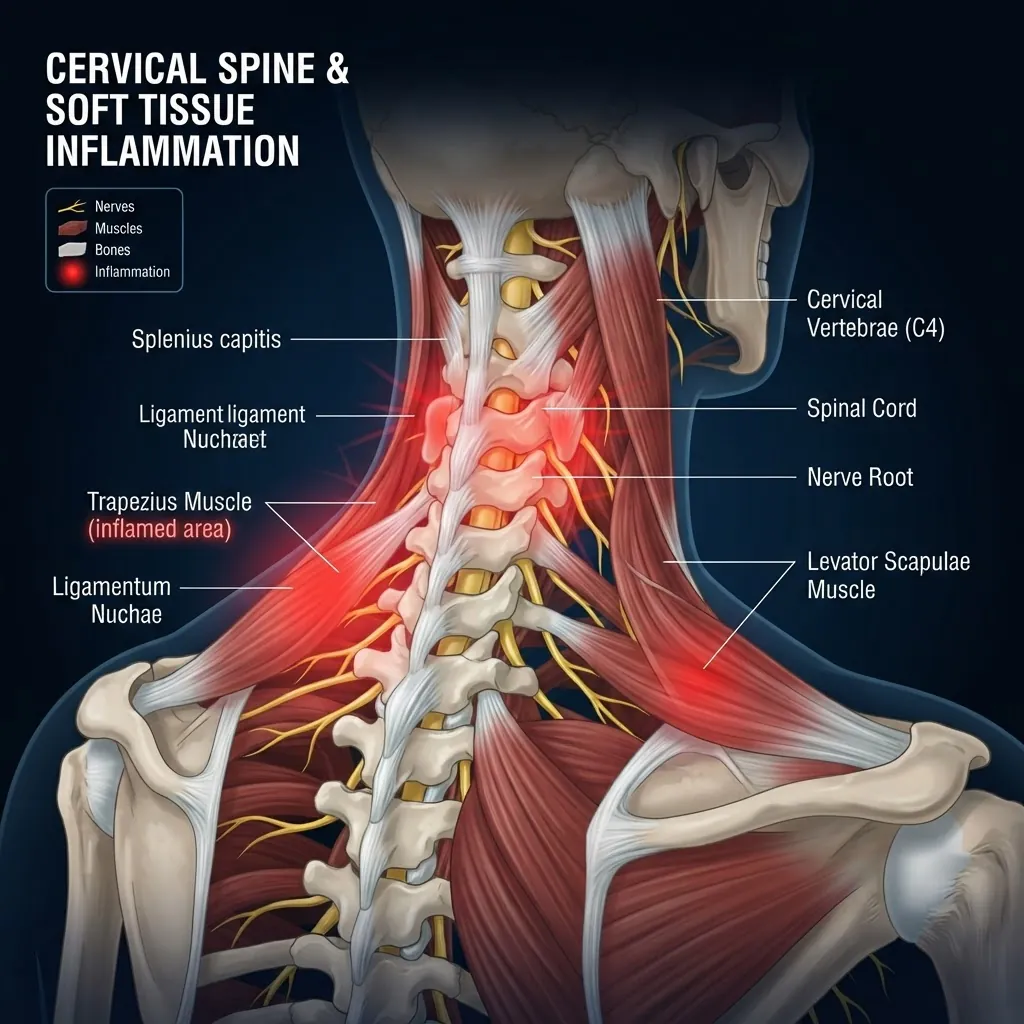
Soft tissue injuries in the neck and shoulders can take days to become painful — adrenaline masks the initial damage.
According to Harvard Health's research on the stress response, when the threat passes, cortisol levels fall and the parasympathetic nervous system — the "brake" — dampens the stress response. That's when the adrenaline wears off. And that's when the pain starts.
The Adrenaline Window: After an accident, you may have a window of hours — or even a day or more — where you genuinely don't feel injured. This is not evidence that you're uninjured. It's your body's survival chemistry doing its job. The absence of pain immediately after a crash tells you nothing about the presence of injury.
For me, that adrenaline window lasted through the rest of the ride home. I rode from Ottawa through Quebec and into New Brunswick with a damaged saddlebag, stopped for gas, ate meals, and went to bed thinking I was fine. My body was still running on the chemicals that got me through the impact. It was only as those chemicals cleared my system over the following days that the real damage started making itself known.
How Soft Tissue Injuries Develop Over Days
Most of the injuries from a rear-end motorcycle collision are soft tissue injuries — damage to muscles, ligaments, tendons, and nerves. Unlike a broken bone that hurts immediately and shows up clearly on an X-ray, soft tissue damage follows a biological timeline that can take days to fully manifest.
According to Physio-pedia and multiple physiotherapy sources, soft tissue healing happens in stages:
Stage 1: Acute Inflammatory Phase (First 24-72 hours)
Immediately after injury, your body sends blood and fluid to the damaged area. This causes swelling, heat, and eventually pain. But here's the key: if adrenaline is still suppressing your pain signals, you may not feel this inflammation building. The swelling is happening — you just can't feel it yet.
Stage 2: Repair Phase (Starts 24-48 hours, peaks at 2-3 weeks)
Your body starts producing collagen and forming scar tissue to repair the damaged fibers. This is when stiffness really sets in. For me, this is when things went downhill — about a week after the accident, the inflammation had built up enough that the pain broke through whatever was left of the adrenaline buffer.
Stage 3: Remodeling Phase (Weeks to months)
The scar tissue is reorganized and strengthened. This is the longest phase and why soft tissue injuries can linger for months if not properly treated.
Why the Delay Almost Got Me: Swelling from soft tissue injury typically peaks at 24-48 hours, but when multiple areas are damaged — neck, both shoulders, arm, hand — the cumulative inflammation can build over a week or more. The more areas involved, the longer it takes for the pain to reach a level that overrides your body's pain suppression. By day 7, my hand was so swollen I couldn't close it. That didn't happen overnight — it was building the entire week.
The Cleveland Clinic notes that whiplash symptoms — which are a form of soft tissue injury — can take 12 hours to appear, and sometimes "a full day or even a few days for all the symptoms to show up." In my case, it took a week. The medical literature supports this: delayed onset of a week or more is not unusual when multiple soft tissue areas are involved.
Delayed Symptoms to Watch For
Based on my experience and the medical research, here are the symptoms that can appear hours, days, or even weeks after a motorcycle accident. If you've been in a crash and any of these show up, get to a doctor — don't wait.
Neck Pain and Stiffness
This is the classic whiplash symptom. The Cleveland Clinic lists symptoms in order of severity: stiffness and tenderness, neck pain that spreads to your head, face, shoulder, and/or shoulder blade, muscle spasms, and swelling. The pain may not start right away — it can take 12 hours to several days.
Shoulder Pain (One or Both)
When you're hit from behind on a motorcycle, your arms are on the handlebars and your shoulders absorb significant force. The impact can cause rotator cuff injuries, sprains, and strains. According to orthopedic sources, rotator cuff symptoms include pain while lifting or lowering your arm, muscle weakness, and pain while resting or sleeping. Both of my shoulders were affected.
Arm, Elbow, and Hand Pain
This was one of the most surprising symptoms for me. I didn't expect hand pain from a rear-end collision. But the medical explanation is clear: whiplash and neck injuries can radiate down through the shoulders, arms, and into the hands. The nerves that run from your cervical spine through your shoulders and down your arms can be compressed or irritated by the soft tissue damage in your neck — and that nerve pain shows up in your hands.
In my case, the swelling in my hand was severe enough that I couldn't close it. According to medical sources, severe swelling, difficulty moving, and numbness or tingling can indicate nerve damage, fracture, or dislocation — all of which require immediate medical evaluation.
Red Flag Symptoms — Go to the Hospital Immediately: Numbness or tingling in your arms or hands, severe swelling that limits movement, pain that worsens over days rather than improving, dizziness or vision changes, difficulty swallowing, or radiating pain from your neck down through your shoulders and arms. Any of these can indicate nerve damage, spinal injury, or other serious conditions that need urgent treatment.
Headaches
Headaches that develop after an accident can be a symptom of whiplash, concussion, or traumatic brain injury. The Cleveland Clinic lists headaches as a whiplash symptom. If a headache develops hours or days after a crash and is accompanied by dizziness, vision changes, or nausea, it needs immediate evaluation.
Back Pain
Lower back pain can indicate spinal injuries, herniated discs, or soft tissue damage in the lumbar region. On a motorcycle, your entire spine absorbs the force of a rear-end impact — not just your neck.
Numbness or Tingling
This is a sign of nerve involvement. The Cleveland Clinic specifically lists numbness and a "pins and needles" feeling in the neck, upper back, shoulders, or upper arms as whiplash symptoms. If this shows up in your hands — as it did for me — it can indicate that nerve pathways from your neck through your shoulders are being compressed by inflammation.
What to Do at the Scene
Here's what I should have done differently, and what every rider should do after a motorcycle accident — whether you think you're injured or not.
1. Get to Safety First
If you can move, get yourself and your bike out of traffic. A secondary collision is a real risk, especially on a highway. Move to the shoulder or a safe area off the road.
2. Call 911
Call for police and medical assistance. Even if you think the damage is minor, you need a police report. In Ontario, accident reports are critical for insurance claims. Having emergency responders on scene creates an official record of the accident.
3. Don't Remove Your Gear Immediately
Your helmet and riding gear may be protecting injuries you can't feel yet. If you suspect any neck or back injury, keep your helmet on and wait for paramedics. Removing a helmet with a neck injury can cause additional damage.
4. Document Everything
This is critical and I can't emphasize it enough. Use your phone to photograph:
• The position of both motorcycles
• Damage to your bike (especially the rear in a rear-end collision)
• The road and traffic conditions
• Any visible injuries, even minor ones
• The other rider's bike, plate, and helmet
• Road signs or landmarks that show location
Helmet Camera Footage: If you ride with an action camera (I use the Insta360 Ace Pro 2 and Insta360 X5), the footage of the accident is invaluable. Ontario courts and insurance companies increasingly accept video evidence to establish fault. If your camera was recording, save that footage immediately and back it up — don't let it overwrite.
5. Get Witness Information
If anyone saw the accident, get their name and phone number. Witness statements can make the difference in an insurance claim, especially when the other party disputes what happened.
6. Accept Medical Evaluation at the Scene
If paramedics offer to evaluate you, let them. Even if you feel fine. Their assessment becomes part of the medical record — and that record matters both for your health and for insurance purposes. I didn't do this, and it's one of my biggest regrets.
What to Do in the Days After

A week after the accident, my helmet and gloves ended up next to a hospital bed instead of on a ride.
See a Doctor Within 24 Hours — No Exceptions
This is the single most important thing I failed to do. Even if you feel completely fine, get a medical evaluation within 24 hours of the accident. Here's why:
First, adrenaline can mask injuries for hours or days. A doctor can identify soft tissue damage, nerve involvement, or other issues before they become severe. Second, medical records from a visit shortly after the accident establish a direct link between the crash and your injuries. If you wait a week — like I did — insurance companies may argue your injuries weren't caused by the accident.
My Biggest Mistake: I didn't see a doctor after the accident because I felt fine. By the time I ended up in the hospital a week later, I had no medical record connecting my injuries to the crash. That makes everything harder — treatment, insurance, documentation. Don't make this mistake. Even if you feel 100%, get checked within 24 hours.
Monitor for Delayed Symptoms
In the days following your accident, pay close attention to your body. Keep a written log of any symptoms and when they appear:
• Any new pain, even mild
• Stiffness that wasn't there before
• Swelling in your hands, arms, or joints
• Numbness, tingling, or "pins and needles"
• Headaches
• Dizziness or balance issues
• Difficulty sleeping (pain often worsens at night)
• Reduced range of motion
Follow the R.I.C.E. Protocol for Swelling
For soft tissue injuries in the first 48-72 hours, medical sources recommend the R.I.C.E. protocol: Rest, Ice, Compression, Elevation. This can help manage inflammation while you wait for a medical evaluation. But do not use this as a substitute for seeing a doctor — it's a stopgap, not a treatment plan.
Don't Return to Riding Until Cleared
If you're experiencing any symptoms, do not get back on the motorcycle until a doctor has evaluated you and cleared you to ride. Riding with soft tissue injuries — especially neck and shoulder damage — increases your risk of a more serious crash because your reaction time and physical control are compromised.
Insurance and Documentation
Based on research from Ontario-specific legal sources (McLeish Orlando LLP, a Toronto personal injury firm that specializes in motorcycle accidents), here's what you need to know about the insurance process after a motorcycle accident in Canada.
Report to Your Insurance Company Quickly
In Ontario, you must notify your insurer within 7 days of the accident — or as soon as reasonably possible — to qualify for Statutory Accident Benefits under the no-fault insurance system. Failing to report on time or providing incomplete information can lead to a denied claim.
Canadian Riders: In Ontario's no-fault insurance system, you're entitled to accident benefits regardless of who caused the accident. This includes income replacement and medical care. In the Atlantic provinces (NB, NS, PEI, NL), the specifics differ — check with your provincial insurance regulator. But the principle is the same: report promptly and document everything.
Don't Admit Fault at the Scene
This is standard advice from every legal source I found. Stick to the facts. Don't speculate about what happened or who was responsible. Early admissions — even casual ones like "I think I stopped pretty quick" — can be used against you.
Keep Every Piece of Documentation
Build a file immediately and keep everything:
• Police report number and copy
• Photos from the scene
• Camera footage (back this up immediately)
• Witness contact information
• Medical records from every visit
• Receipts for any expenses related to the accident (towing, gear repair, medical costs, parking at the hospital)
• A written timeline of symptoms as they appear
• Any correspondence with the other party's insurance
Get Medical Records for Every Visit
This is critical. Every time you see a doctor, physiotherapist, or specialist related to the accident, make sure there's a record. If you go to the ER a week after the crash, tell them explicitly: "I was in a motorcycle accident on [date] and these symptoms have been developing since then." Make sure that information gets into your chart.
Consider Legal Advice Early
If your injuries are serious — and if you're in the hospital a week after the accident, they are — consult a personal injury lawyer who handles motorcycle accidents as soon as possible. Early legal advice helps preserve your rights and can significantly affect the outcome. Most personal injury lawyers in Canada offer free consultations and work on contingency (no fee unless you win).
Mistakes I Made
I'll be honest about what I did wrong, because I think it's more useful than pretending I handled this perfectly:
1. I didn't seek medical attention at the scene. Paramedics weren't called, and even if they had been, I would have waved them off. I felt fine. That was the adrenaline talking, not reality. A medical evaluation at the scene would have created a record and possibly caught early signs of soft tissue damage.
2. I didn't see a doctor within 24 hours. This is the big one. If I had gone to a clinic or ER the next day and said "I was rear-ended on my motorcycle," I would have a medical record linking my current injuries to the accident. Instead, I waited a week until I was in so much pain I had no choice. That gap makes everything harder.
3. I rode for three more days after the accident. I rode from Ottawa to Hawkesbury to Edmundston to Dieppe with a damaged bike and an injured body I didn't know about yet. Every hour on the bike added strain to already-damaged soft tissue. If I'd been evaluated and told not to ride, I would have trailered the bike or gotten a ride.
4. I didn't start a symptom log. When the pain started building over the week, I didn't write down what I was feeling and when. By the time I got to the hospital, I had a general sense of "it got worse over the week" but no specific timeline. A daily symptom log would have been valuable for both my doctors and my insurance claim.
The Takeaway
I've been riding for over 200,000 km (124,000 miles) across my lifetime. I've ridden to Newfoundland, Montana, the Tail of the Dragon, Sturgis, Daytona, and through 28 states and most of Canada. I've been in bad weather, heavy traffic, construction zones, and on some of the best and worst roads in North America. I thought I knew what to expect from a motorcycle accident.
I didn't expect to feel fine and then end up in the hospital a week later. That's the part I want other riders to understand.
If you're in a motorcycle accident — even a "minor" one, even if you feel completely fine — do these three things:
1. Get medical evaluation within 24 hours. Not when symptoms appear. Not when the pain gets bad. Within 24 hours. Period.
2. Start a symptom log the same day. Write down how you feel, every day, even if you feel fine. Note any changes, no matter how small. This becomes evidence for both your doctor and your insurance.
3. Document everything at the scene. Photos, video, witness info, police report. Do it before you leave the scene, while the evidence is right in front of you.
The accident I walked away from turned into a week-long medical emergency that I'm still dealing with. The impact took a split second. The consequences are still unfolding. If you ride long enough, you may find yourself in the same situation. When you do, don't trust how you feel. Trust the medical process.
Ride safe out there. And if the unthinkable happens, take it seriously — even when your body tells you not to.
Sources Referenced
• Cleveland Clinic — Whiplash (Neck Strain): Symptoms, Causes, and Treatment. my.clevelandclinic.org
• Harvard Health — Understanding the Stress Response. health.harvard.edu
• Physio-pedia — Soft Tissue Healing. physio-pedia.com
• McLeish Orlando LLP — What to Do After a Motorcycle Accident: Legal Steps Every Ontario Rider Should Know. mcleishorlando.com
• Complete Care — Hand, Wrist and Shoulder Pain After a Car Accident. complete-care.com
• StatPearls (NCBI) — Physiology, Stress Reaction. ncbi.nlm.nih.gov
Buy on Amazon
Affiliate Disclosure: As an Amazon Associate I earn from qualifying purchases. If you buy through these links, I may earn a small commission at no extra cost to you.